

Uff-da. This one’s been on my mind for a while. And by a while, I mean years.
I’ve wrestled with whether I should write it, how to write it, and whether I really wanted to open this particular can of worms. Which, ironically, is probably a pretty fitting way to begin an article about the fear of what other people think. Ha!
But something happened over a year ago that made a lot of things click.
I went through training to become a certified Core Values Index (CVI) coach through Hardwired Coaching. And let me tell you… there were moments during that training when I felt like I’d been punched square in the gut.
Not because the training was bad. Quite the opposite. But because I started recognizing patterns.
In people. In leadership. In churches. In pastors. And, unfortunately, in myself.
You see, I’ve spent years serving in church leadership. And as I sat there learning about how people are naturally wired, what motivates them, what they fear, and how those fears can influence their decisions, I found myself looking back at some of those years a little differently.
Some of what I learned was encouraging. Some of it was fascinating. And some of it was downright convicting.
Because I started wondering whether one of the greatest problems facing the modern American church has a lot more to do with fear than we’d care to admit.
I wonder how many pastors are so afraid of losing people that they’ve slowly stopped telling them the truth.
Not necessarily all at once. Not because they woke up one morning and decided to abandon Scripture. But because compromise can happen a little at a time.
A difficult passage gets skipped. A controversial doctrine gets softened. A necessary confrontation gets postponed. A sermon gets adjusted so nobody feels particularly uncomfortable.
And before long, a pastor who genuinely loves people may find himself more concerned about keeping them happy than faithfully proclaiming what God has said.
That’s a serious problem. And the more I study Scripture, the more convinced I am that it isn’t a new one.
Paul Warned Us About This Almost 2,000 Years Ago
Before we get into the CVI, we need to start with Scripture. Because this is ultimately a biblical issue, not a personality issue.
And there’s a passage in 2 Timothy that ought to make every pastor, elder, and church leader seriously uncomfortable.
In 2 Timothy 4:1–5, Paul gives Timothy a solemn charge before God and Christ Jesus.
His command? Preach the Word. Be ready whether it’s convenient or inconvenient. Correct. Rebuke. Exhort. With patience and instruction.
And then comes the warning.
2 Timothy 4:3–4 describes a time when people will no longer tolerate sound doctrine. Instead, they’ll gather teachers who suit their own desires, wanting their ears tickled rather than hearing the truth.
“For the time is coming when people will not endure sound teaching, but having itching ears they will accumulate for themselves teachers to suit their own passions, and will turn away from listening to the truth and wander off into myths.”
2 Timothy 4:3–4 (ESV)
Uff-da. Tell me that doesn’t sound familiar.
Paul didn’t say people would stop wanting religious experiences. He didn’t say they’d stop gathering together. He didn’t say they’d stop looking for teachers.
Quite the opposite. They’d accumulate teachers. They’d still want sermons. They’d still want spiritual encouragement. They’d still want someone standing in front of them telling them how to live.
They just wouldn’t want someone telling them what they didn’t want to hear.
And here’s what’s fascinating. This passage reveals a problem on both sides of the pulpit.
People who want their ears tickled. And teachers willing to tickle them. One creates demand. The other provides the supply.
And pretty soon, everybody’s happy. Attendance is great. People love the pastor. The sermons are encouraging. The church is growing.
But there’s one rather significant problem. Are they hearing the Word of God faithfully preached? Or are they hearing just enough Scripture to make them feel like they’ve been to church?
Because those are two very different things.
Charles Spurgeon Saw the Danger Long Before the Megachurch Movement
I’ve been thinking a lot about Charles Spurgeon as I’ve wrestled with this.
Spurgeon didn’t have the Core Values Index. He didn’t have modern personality assessments or leadership coaching programs.
But he understood human nature. He understood the temptations pastors face. And he understood that the Church was in serious trouble when its leaders began compromising biblical truth.
His concerns were particularly evident in the Down-Grade Controversy of the late 1880s. At the time, Spurgeon was watching ministers and churches begin abandoning or questioning foundational doctrines:
- The authority and inspiration of Scripture.
- The substitutionary atonement of Christ.
- The reality of eternal punishment.
- The need to be saved through Christ in this life, with no “second chance” after death.
And he wasn’t willing to simply smile, maintain the peace, and pretend everything was fine.
Writing in August 1887, in “Another Word Concerning the Down-Grade”, he warned that some of the new theology was so radically different from biblical Christianity that it could hardly be called the same religion. In his words, it was “no more Christianity than chalk is cheese.”
He described a theological movement replacing the faith while presenting itself as little more than an improved version of it. It “palms itself off as the old faith with slight improvements,” he wrote.
Think about that. An improved version of Christianity.
A Christianity that’s a little less offensive. A little more culturally acceptable. A little easier for people to embrace. A little less demanding. A little more comfortable.
Does that sound familiar?
Spurgeon wasn’t arguing that every church had to agree with him on every secondary theological question. He maintained fellowship with Christians who disagreed with him on plenty of matters. But when it came to the essentials of the gospel, he refused to compromise.
And it cost him.
He withdrew from the Baptist Union in October 1887. He lost friendships. He faced tremendous criticism. And some of the very people he had invested years training and supporting turned against him.
But Spurgeon believed that faithfulness to the truth was worth that cost.
And I can’t help but wonder… how many pastors today would be willing to lose their reputation, their closest relationships, or even their ministry position rather than compromise biblical truth?
How many would stand firm if doing so meant watching the church shrink? Or losing its largest donors? Or becoming unpopular in their community?
Because those questions aren’t hypothetical. They’re the kinds of decisions that reveal what we actually value.
The Problem With Wanting Everyone to Like You
Here’s where the Core Values Index enters the picture. And I think it helps explain something about church leadership that we don’t talk about nearly enough.
There are four primary core values identified by the CVI: Builder, Merchant, Innovator, and Banker.

I firmly suspect that a substantial percentage of pastors have a high Merchant score, whether as their primary or secondary core value.
Now, that’s my hypothesis based on experience. I haven’t surveyed thousands of pastors to verify it. But I think there’s a compelling reason to consider it.
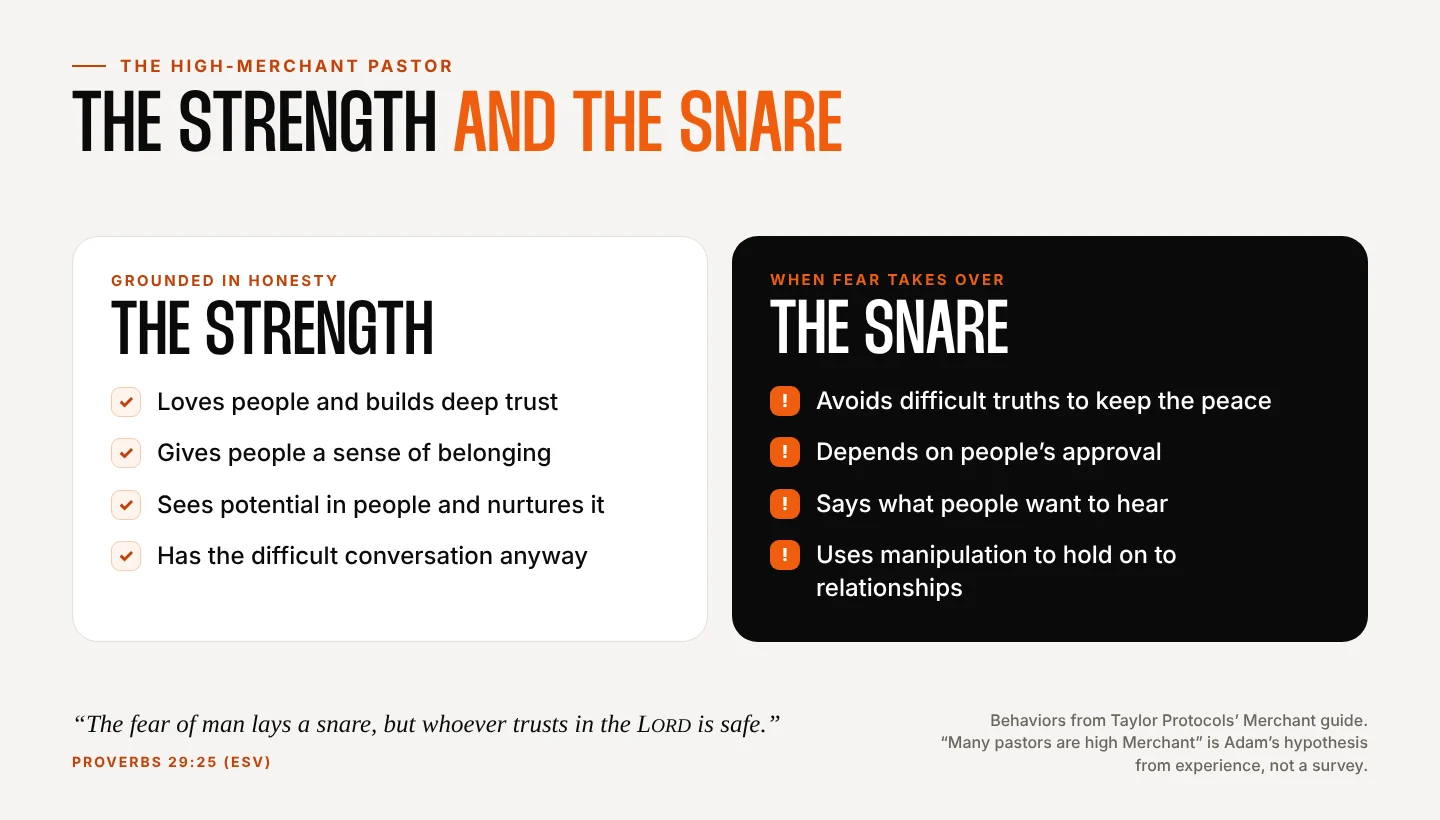
Merchants are naturally relationship-oriented. They value love, connection, inspiration, beauty, and possibilities. They often have an incredible ability to encourage people, create meaningful relationships, and bring others together.
And frankly, those sound like some pretty wonderful qualities for a pastor.
A pastor should love people. He should care deeply about them. He should be compassionate. He should desire healthy relationships. He should encourage, comfort, and build up the people God has entrusted to his care.
But there’s another side to this. And it’s where I started getting a little uncomfortable during my coaching training.
When Merchants become threatened or fearful, their relational strengths can become distorted. Taylor Protocols’ own Merchant guide describes it this way: a Merchant’s natural desire for connection “can turn into people-pleasing or manipulation.” They may become:
- More concerned about acceptance.
- More sensitive to rejection.
- More likely to avoid conflict.
- More tempted to manipulate circumstances to preserve a relationship.
- And sometimes more willing to tell people what they want to hear.
Now think about that in the context of a pastor.
A man who genuinely loves his congregation. Who values his relationships. Who finds tremendous joy in being appreciated. Who wants people to feel welcome and connected.
What happens when he begins to fear that faithfully preaching certain passages might cause people to leave?
What happens when he knows confronting someone’s sin might destroy a relationship?
What happens when he worries that church members might stop liking him? Or that attendance might decline? Or that the church’s financial support might suffer?
And how easy would it be to justify avoiding those things by telling himself he’s simply being loving?
Sometimes what we call being loving is actually just being afraid of being disliked.
Ouch. I know. That one stings.
And it stings because I can recognize some of these tendencies in myself.
The Fear of Man Is a Snare
Proverbs 29:25 teaches that the fear of man brings a snare, while trusting in the Lord brings security.
“The fear of man lays a snare, but whoever trusts in the Lord is safe.”
Proverbs 29:25 (ESV)
That’s remarkably simple. And remarkably convicting.
Because fear doesn’t always look like fear. Sometimes it looks like wisdom. Sometimes it looks like patience. Sometimes it looks like being strategic. Sometimes it looks like maintaining unity. Sometimes it looks like showing grace.
And sometimes those things really are biblical and appropriate.
But sometimes they’re just respectable names for something we don’t want to admit.
We’re afraid. Afraid of confrontation. Afraid of rejection. Afraid of losing someone. Afraid of what people will say. Afraid of what might happen if we faithfully obey God.
And here’s what makes that especially dangerous for a pastor. A pastor’s responsibility isn’t to protect his own popularity. It’s to shepherd God’s people.
And there are times when faithfully shepherding someone requires telling them something they desperately don’t want to hear.
Galatians 1:10 presents the issue directly. Paul contrasts seeking human approval with being a servant of Christ.
“For am I now seeking the approval of man, or of God? Or am I trying to please man? If I were still trying to please man, I would not be a servant of Christ.”
Galatians 1:10 (ESV)
And his conclusion is sobering. You cannot make the approval of people your ultimate objective and remain faithful to Christ as your Master.
That’s not an invitation to be rude. It’s not permission to be arrogant. And it’s certainly not an excuse to treat people poorly and then claim persecution when they object.
But it is a reminder that the fear of God must outweigh the fear of man.
Always.
Are We Feeding Sheep or Entertaining Goats?
This is where I think things have gotten particularly concerning in the American church.
We have become incredibly good at creating church experiences. Bigger buildings. More impressive stages. Better lighting. More polished music. Beautiful gathering spaces. Coffee shops. Branded merchandise. Sermons that sound like motivational speeches. And entire services carefully planned around creating an atmosphere people will enjoy.
Now, I need to say something here. I’m not opposed to beautiful spaces.
I literally build websites, design graphics, and help businesses with branding and marketing for a living. I appreciate excellence. And Spurgeon himself preached to thousands of people in a large, purpose-built auditorium.
So the building isn’t inherently the problem. The lighting isn’t inherently the problem. The coffee isn’t inherently the problem.
Although, depending on the coffee, we might have a separate conversation. =P
But here’s the question. Have we become more concerned with attracting people to a building than faithfully feeding the people inside it?
In John 21:15–17, Jesus repeatedly instructs Peter to tend and shepherd His sheep.
Not entertain them. Not impress them. Not create an experience they’ll rave about on social media.
Shepherd them. Feed them. Care for them.
And what are God’s people to be fed? The Word of God.
Spurgeon understood this. In his 1876 sermon Conversions Desired, he challenged preachers not to settle for a sermon that merely instructs or pleases. “Do not believe that you have done your work when you have taught the people,” he told them; “you must never rest till they believe in Jesus Christ.”
He argued that preaching must aim at bringing people to Christ, not simply producing an enjoyable religious experience. He even noted that some come to hear a preacher “out of the idlest curiosity,” looking for something to amuse them, and that it’s the truth, applied by the Spirit, that actually reaches their hearts.
And that’s the distinction I think we’ve lost in many churches.
We’re asking whether people enjoyed the service. Whether they liked the music. Whether they connected with the sermon. Whether they felt welcomed. Whether they’ll come back.
And none of those questions is inherently wrong.
But shouldn’t our greater concern be whether the Word was faithfully preached? Whether people were confronted with biblical truth? Whether sinners heard the gospel? Whether believers were equipped to grow in holiness? Whether Christ was exalted?
We’ve become remarkably skilled at evaluating church experiences. But are we evaluating faithfulness?
Because you can fill a building with people who love coming to church while leaving them spiritually malnourished.
And that’s terrifying.
The Watchman Who Refuses to Warn
There’s a passage in Ezekiel that I think every pastor ought to spend some serious time studying. Actually, I think every Christian should. But especially those entrusted with spiritual leadership.
In Ezekiel 33:6–9, God uses the illustration of a watchman.
A watchman sees danger approaching. His responsibility is to warn the people. If he faithfully warns them and they refuse to listen, he’s fulfilled his responsibility. But if he sees the danger and refuses to sound the alarm, he’s accountable for failing to warn them.
“But if the watchman sees the sword coming and does not blow the trumpet, so that the people are not warned, and the sword comes and takes any one of them, that person is taken away in his iniquity, but his blood I will require at the watchman’s hand.”
Ezekiel 33:6 (ESV)
Now, Ezekiel’s prophetic commission is not identical to the office of a New Testament pastor. But the principle of responsibility before God is profoundly relevant.
God does not treat silence in the face of danger as an act of love.
And that makes me wonder…
How many pastors see spiritual danger approaching but refuse to sound the alarm because they know some people won’t appreciate the warning?
How many know that a particular teaching is unbiblical but remain silent because confronting it would be controversial?
How many know that someone in the congregation needs correction but avoid the conversation because the relationship means too much to them?
And how many convince themselves that silence is the loving thing to do?
Let me ask something. If your child was about to walk into traffic, would you calmly consider whether warning them might hurt their feelings? Would you worry about sounding too harsh? Would you think about whether they might resent you afterward?
Of course not. You’d do everything you could to protect them. Because love acts when danger is present.
And yet, when it comes to eternal matters, I wonder if we’ve started treating silence as compassion.
A shepherd who refuses to warn the sheep about approaching danger isn’t protecting them. He’s protecting himself from their reaction.
That’s a difficult statement. But I think we need to hear it.
Spurgeon Wasn’t Interested in Preaching a More Acceptable Gospel
In his 1874 sermon Infallibility—Where to Find It and How to Use It, Spurgeon made the source of his authority unmistakably clear:
The Bible, the whole Bible, and nothing but the Bible, is our religion.
C. H. Spurgeon, December 20, 1874
That’s a pretty incredible statement. And think about what it means.
Not the parts of the Bible people find culturally acceptable. Not the passages that make us feel good. Not the doctrines that are easy to communicate. Not whatever is currently popular.
The whole Bible.
Even when it confronts our preferences. Even when it challenges cultural assumptions. Even when people disagree. Even when it costs us.
Spurgeon wasn’t calling for preachers to manufacture controversy.
In fact, in his 1855 sermon Preach the Gospel, he also criticized ministers who repeatedly emphasized only a narrow selection of doctrines while neglecting the rest of Scripture. (In that same sermon, he rebuked those who “keep back certain truths from the people, because they are afraid of them.”)
And that’s not biblical faithfulness either.
He’s called to preach the Word.
All of it.
The passages about grace. The passages about judgment. The passages about love. The passages about repentance. The passages about God’s mercy. The passages about His holiness. The passages that comfort us. And the passages that convict us.
We don’t get to decide which parts are worth preaching based on how well we think they’ll be received.
What Happened to Preaching the Whole Counsel of God?
In Acts 20, Paul addresses the elders of the church in Ephesus. And there’s something particularly interesting about what he tells them.
In Acts 20:26–27, Paul declares himself innocent concerning their blood because he had not avoided proclaiming the whole purpose of God.
Think about that. Paul viewed his willingness to faithfully communicate God’s truth as part of his responsibility before God.
And just a few verses later, in Acts 20:28–30, he warns the elders to guard themselves and the flock because false teachers would arise, even from among their own number.
In other words, church leaders have a responsibility to protect the flock from spiritual danger.
Not simply make them feel welcome. Not simply create community. Not simply inspire them.
Those things may have their place. But pastors are called to guard, shepherd, and teach.
And that sometimes requires courage. Real courage. The kind that costs something.
Not the kind that receives thunderous applause from people who already agree with you.
The kind that requires lovingly confronting someone you deeply care about. The kind that means preaching a difficult passage even when you know it’s going to create uncomfortable conversations afterward. The kind that means losing the approval of someone whose relationship means a great deal to you.
And doing it anyway. Because you fear God more than you fear their response.
What Spurgeon Was Willing to Lose
I keep coming back to the Down-Grade Controversy. Because it wasn’t simply an example of Spurgeon writing strongly worded articles about the problems he saw.
He actually paid a price.
When he challenged theological compromise, his position became increasingly unpopular among influential ministers.
He was criticized. He was censured: in January 1888, the Baptist Union’s Council passed a resolution censuring him, and he answered it in “The Baptist Union Censure”. His relationships suffered. In the preface to his magazine’s 1888 volume, he admitted that his “protest against error has lost us many a friend.”
And he found himself increasingly isolated from people who had once supported him. When he reorganized the fellowship of men trained at his own Pastors’ College around a clear declaration of faith in 1888, at least 80 of them rejected it and sided with the Union. Spurgeon called it “the desertion of my own men.”
One of his most striking statements came in an address to the ministers and students of that same Pastors’ College, later published in An All-Round Ministry. He was willing to endure years of public condemnation, trusting that the future would ultimately vindicate his stand for the truth:
“For my part, I am quite willing to be eaten of dogs for the next fifty years; but the more distant future shall vindicate me. I have dealt honestly before the living God.”
C. H. Spurgeon, “The Preacher’s Power, and the Conditions of Obtaining It”
That’s conviction.
And I can’t help but contrast that with the pressure so many churches face today.
What if a pastor knows preaching faithfully through a particular passage will offend some of his congregation? What if he knows teaching a particular doctrine will result in angry emails? What if influential families threaten to leave? What if church attendance declines? What if giving decreases? What if the building project gets delayed? What if people begin criticizing his leadership?
Does he change the message? Does he avoid the subject? Does he find a way to soften the truth?
Or does he faithfully preach what God has said?
I think Spurgeon’s example forces us to consider whether our commitment to biblical truth is genuinely greater than our desire for acceptance.
And I’m afraid we might not always like the answer.
The Tragedy of Shepherds Who Feed Themselves
Ezekiel 34 is another passage that ought to make church leaders uncomfortable.
God confronts the shepherds of Israel for their failure to care for His people. Instead of strengthening the weak, healing the sick, caring for the injured, and seeking the lost, they were serving themselves.
Again, the historical context is Israel’s unfaithful leaders. We shouldn’t ignore that context. But the warning against self-serving spiritual leadership is painfully relevant.
Because ministry can become about the leader. His reputation. His influence. His success. His vision. His church. His numbers.
And slowly, subtly, the focus shifts.
What began as a desire to serve God’s people becomes a desire to build something impressive.
And when a leader’s identity becomes tied to the success of his ministry, anything that threatens that success can begin to feel personal.
Criticism becomes a threat. Disagreement becomes disloyalty. Declining attendance becomes failure. And uncomfortable biblical teaching becomes a risk.
That’s a dangerous place to be.
Because at that point, we’re no longer simply shepherding people. We’re protecting something we’ve built.
And sometimes that something is our own reputation.
The CVI Helped Me See This in Myself
Now here’s where things get personal.
Because I don’t want to write an entire article about pastors struggling with people-pleasing without acknowledging that I’ve had to examine these same tendencies in my own life.
As I’ve shared before, my primary CVI value is Innovator. My secondary is Merchant. (I shared more of that story here.)
And that’s an interesting combination.
My Innovator loves figuring things out. I question things constantly. I want to understand why something works, why it doesn’t, and what could be improved. If something doesn’t make sense, I have a hard time simply ignoring it.
But my Merchant? That’s where relationships become incredibly important. Loyalty. Connection. Trust. Being appreciated. Being understood.
And those things can create some interesting internal conflicts.
My Innovator wants to challenge something that seems wrong. My Merchant knows that challenging it might damage a relationship.
My Innovator wants to get to the bottom of an issue. My Merchant worries about how someone might respond.
And I can look back at years of my own leadership and recognize moments when those competing motivations influenced how I handled situations.
Sometimes I spoke up. Sometimes I should have listened more. Sometimes I probably could have handled conflict much better. And sometimes I wonder whether I avoided addressing something as directly as I should have.
That’s humbling.
Because it’s easy to recognize when someone else is operating out of fear. It’s a little more uncomfortable when you start recognizing that same fear in yourself.
And here’s the thing. My wiring doesn’t excuse my sin.
It might help me understand why certain things are particularly challenging for me. It might explain some of my natural tendencies. It might reveal patterns that I otherwise wouldn’t recognize.
But it doesn’t justify an unbiblical response.
And that’s something I think every Christian needs to understand when exploring tools like the CVI. They’re not replacements for Scripture. They’re not substitutes for spiritual maturity. And they certainly don’t determine whether someone is qualified to lead a church.
But they can help expose blind spots. And sometimes those blind spots reveal areas where repentance and growth are needed.
That’s what made my coaching training so valuable. I wasn’t just learning how to understand other people. I was learning some things about myself that I didn’t particularly enjoy discovering.
Pastors Need People Who Will Tell Them the Truth
This is another area where understanding different CVI types can be incredibly helpful.
Let’s say a pastor has a high Merchant score. He’s relational. He’s inspiring. He’s gifted at bringing people together. He loves creating beautiful environments and building meaningful connections.
Those are wonderful strengths.
But what happens if he’s surrounded by leaders who are wired similarly?
People who are equally concerned about maintaining harmony. People who don’t like uncomfortable conversations. People who would rather encourage than confront. People who are more naturally inclined to preserve relationships than challenge decisions.
You could end up with a leadership team that genuinely loves one another but struggles to confront serious problems.
And that’s why I think the different CVI types can complement one another so well.
A Banker, for example, may be more naturally inclined toward accuracy, knowledge, consistency, and careful evaluation. He may be the one willing to ask the questions nobody else wants to ask.
Is this actually consistent with Scripture? Are we overlooking something? Are we making this decision because it’s right or because it’s popular?
And those are good questions. Questions a pastor should welcome.
But here’s the caution.
Being a Banker doesn’t automatically make someone doctrinally sound. Being an Innovator doesn’t automatically make someone wise. Being a Merchant doesn’t automatically make someone compassionate. And being a Builder doesn’t automatically make someone a great leader.
Every wiring has strengths. Every wiring has weaknesses. And every person is a sinner in need of God’s grace.
Church leadership must first be grounded in the biblical qualifications for elders found in passages like 1 Timothy 3 and Titus 1.
But among biblically qualified men, I believe understanding their different natural strengths and vulnerabilities can help them lead and hold one another accountable more effectively.
Because no pastor should be surrounded exclusively by people who tell him what he wants to hear.
That’s not accountability. That’s an echo chamber.
And when the consequences involve the spiritual care of God’s people, that’s a pretty dangerous thing to create.
Imagine Standing Before God and Explaining Why You Didn’t Preach Something
James 3:1 warns that those who teach will incur a stricter judgment.
That’s sobering. And I wonder how much differently we would approach church leadership if that truth occupied more of our thinking.
Imagine a pastor standing before God.
Not before his congregation. Not before his elder board. Not before a church growth consultant. Not before the people who praised his sermons.
Before God.
What will matter then? How beautiful the stage was? How many people attended? How impressive the church website looked? How popular the pastor was? How many people told him they loved his preaching?
Or whether he faithfully carried out the responsibility God entrusted to him?
I think about Paul’s words in 1 Corinthians 4:1–5, where he describes ministers as stewards of God’s mysteries and emphasizes faithfulness.
A steward isn’t the owner. He doesn’t get to change the message. He doesn’t get to decide which commands matter. He’s responsible for faithfully handling what has been entrusted to him.
And that’s exactly what pastoral ministry is. A stewardship.
Not a platform for personal popularity. Not an opportunity to build a personal brand. Not a business where customer satisfaction determines what gets taught.
A sacred responsibility to care for the people of God through the faithful ministry of His Word.
And that ought to create a tremendous sense of humility.
Because pastors aren’t ultimately accountable to the people who enjoy their sermons. They’re accountable to the God whose Word they preach.
The Church Doesn’t Need More Entertainers
In 1874, preaching from Matthew 28 in The Power of the Risen Saviour, Spurgeon prayed for God to raise up faithful and courageous leaders.
He longed for men who would stand as defenders of the truth. In his words, “pillars of the Lord’s house, bulwarks of the truth, champions in the camp of Israel.”
Not merely gifted speakers. Not merely impressive personalities. Not merely men capable of drawing enormous crowds.
Men who would faithfully proclaim Christ.
And in his 1886 sermon Christ and His Co-Workers, Spurgeon emphasized the enduring power of proclaiming the gospel even as human inventions and methods come and go. People had tried “all sorts of new inventions and contrivances,” he said, but the telling out of Christ’s name and gospel “will be found to be effectual when all things else have failed.”
That should encourage us.
Because here’s what I think we’ve forgotten.
We don’t have to reinvent Christianity. We don’t need to make the gospel more acceptable. We don’t need to soften Scripture so people will like it. We don’t need to figure out how to compete with the entertainment industry.
We need to faithfully proclaim the Word of God. And trust Him with the results.
Now, that doesn’t mean doing ministry poorly. It doesn’t mean refusing to improve communication. It doesn’t mean ignoring opportunities to welcome visitors or serve people well.
But none of those things should ever become more important than faithfully preaching Scripture.
And if they do? We’ve got a problem. A big one.
Because the Church is not a theater. The pastor is not an entertainer. And the congregation is not an audience of customers whose preferences determine the product.
The Church belongs to Christ. And He has already told us what faithfulness looks like.
What If the Church Gets Smaller?
I think this is one of the questions that reveals a lot about our priorities.
What if a pastor begins faithfully preaching through Scripture, addressing difficult doctrines, confronting sin, and refusing to soften biblical truth… and people leave?
What if attendance drops? What if giving decreases? What if some of his closest relationships suffer?
Would we call that failure?
Because I’m afraid we’ve built a church culture where numerical growth is often treated as evidence of success and numerical decline as evidence of failure.
But Scripture doesn’t give us such a simplistic measurement.
Spurgeon himself pastored an enormous congregation. And he certainly desired to see people converted and churches grow. In fact, his sermon Conversions Desired demonstrates how passionately he wanted to see genuine conversions.
So let’s not pretend that numbers don’t matter at all. People matter. Souls matter. We should rejoice when God brings people to repentance and faith.
But the size of a congregation is not, by itself, a reliable measurement of biblical faithfulness.
A church of 5,000 can be faithful. A church of 50 can be faithful. And both can be unfaithful.
The question isn’t simply how many people are attending. It’s what those people are being taught.
Are they growing in their understanding of Scripture? Are they being discipled? Are they being called to repentance and holiness? Are they being equipped to serve? Are they hearing the gospel faithfully proclaimed?
Or have we simply become exceptionally good at creating religious environments that people enjoy?
And here’s a question I think every pastor ought to ask himself.
If faithfully preaching the Word of God caused half my congregation to leave, would I still preach it?
Not because we want people to leave. Not because smaller automatically means holier.
But because faithfulness must never depend on popularity.
Maybe the Problem Isn’t Just the Pastor
There’s another part of this that I think we need to acknowledge.
Pastors aren’t the only ones responsible for this problem. Congregations have a responsibility, too.
Remember 2 Timothy 4? Paul doesn’t just warn about teachers who compromise. He warns about people who seek them out. People who don’t want sound doctrine. People who want teachers who will satisfy their desires.
And I wonder how often we, as church members, contribute to the very problem we’re criticizing.
We say we want biblical preaching. Until the pastor preaches something that confronts us.
We say we want accountability. Until we’re the ones being corrected.
We say we want a church committed to Scripture. Until Scripture challenges something we don’t want to surrender.
Then what? Do we humbly examine what God has said? Or do we start looking for another church?
One where the preaching is a little more encouraging. A little less confrontational. A little more aligned with what we already believe. A little more comfortable.
Perhaps the problem isn’t always that pastors are unwilling to preach the truth. Perhaps some congregations have made it abundantly clear that they don’t want to hear it.
And that doesn’t excuse a pastor who compromises. But it should cause every one of us to examine our own hearts.
Because we can criticize the fear of man in church leadership while simultaneously demanding that our pastors tell us what we want to hear.
And that’s a pretty remarkable contradiction.
So What Do We Do With All of This?
I don’t think the answer is complicated. But I do think it’s difficult.
Pastors need to fear God more than people. Congregations need to desire truth more than comfort. Church leaders need to value accountability more than personal approval.
And all of us need to be willing to examine our own hearts. Not just the hearts of people we disagree with. Our own.
For some pastors, that may mean recognizing that their natural desire to love people and preserve relationships has become an unhealthy fear of rejection.
For others, the issue may be pride. Control. Ambition. A desire for success. A need to be right. Or an obsession with building something impressive.
The CVI can help us recognize patterns in how we’re naturally wired. But Scripture tells us what righteousness looks like. And ultimately, the Holy Spirit must do the work of transforming our hearts.
That’s why I believe tools like the Core Values Index and CVI coaching can be valuable for church leadership teams.
Not because an assessment can fix the Church. It can’t.
But because greater self-awareness can expose weaknesses that might otherwise go unrecognized. And sometimes those weaknesses are quietly influencing decisions that affect an entire congregation.
One Final Question
I’ll end with something that’s been weighing on me.
What if the greatest threat to faithful preaching in some churches isn’t outright hatred of biblical truth? What if it’s something far more subtle?
A pastor who genuinely loves his people. Who desperately wants to maintain relationships. Who wants everyone to feel welcomed. Who wants the church to grow. Who wants people to be happy. Who wants to be appreciated.
All good things, in their proper place.
But what happens when those desires become more important than faithfulness to God’s Word?
What happens when we begin to love people’s approval more than their souls?
What happens when a pastor knows the truth but refuses to preach it because he’s afraid of losing the very people he’s called to shepherd?
I think Spurgeon understood that danger. I know Scripture warns us about it. And I can’t help but wonder how many of us are more susceptible to it than we’d care to admit.
Including me.
Because as much as I want this article to challenge pastors and church leaders, I also want it to challenge myself.
I don’t want to look back on my life and realize that I sacrificed truth to preserve relationships. I don’t want fear to dictate my convictions. And I don’t want to confuse being loving with being agreeable.
I want to love people enough to tell them the truth. Even when it’s difficult. Even when it’s uncomfortable. Even when it costs me something.
And I hope our pastors do, too.
Because if a pastor loves his congregation too much to tell them the truth, does he really love them as he should?
That’s a heavy question. And I think it’s one the modern American church desperately needs to wrestle with.
Uff-da.
P.S. If you’re a pastor, elder, or church leader, I’d encourage you to explore our CVI coaching. It’s been an incredible tool in helping me understand how I’m naturally wired, the strengths that come with that wiring, and some of the vulnerabilities I didn’t fully recognize. Sometimes the most important thing a leader can discover isn’t another strength. It’s a weakness he’s been overlooking for years.
CVI for Church Leaders: FAQ
Is the CVI a personality test?
Not in the usual sense. Personality and behavioral assessments describe how you tend to act, which can shift with your role, stress or environment. The Core Values Index™, developed by Taylor Protocols, is designed to measure your core values, the motivation underneath your behavior, which is why results are expected to stay consistent over time. Everyone carries all four core values (Builder, Merchant, Innovator and Banker) in different proportions.
Can the CVI replace the biblical qualifications for elders?
No. Church leadership must first be grounded in the qualifications Scripture gives in passages like 1 Timothy 3 and Titus 1. The CVI doesn’t measure character, doctrine or spiritual maturity, and it doesn’t make anyone qualified or unqualified to lead a church. It’s a tool for self-awareness among men who are already biblically qualified, so they can understand their natural strengths and blind spots and hold one another accountable.
How does CVI coaching work for a church staff or elder board?
Each person takes the Core Values Index online, which takes about 7–10 minutes. Then each person has a one-on-one debrief with a Certified CVI™ Coach to understand his core values, strengths and conflict tendencies. From there, we work with the leadership team together: mapping how everyone is wired, where the team has gaps, and how to communicate, handle conflict and build accountability across those differences. It starts with a free consultation.
Do you only work with churches in Arizona?
No. AdaptExec is based in Scottsdale, Arizona, and we travel to meet clients in person across the country for workshops, team sessions and leadership coaching. Individual debriefs can also be done virtually.
Sources
- The Spurgeon Archive: “Another Word Concerning the Down-Grade,” The Sword and the Trowel, August 1887, accessed October 2026.
- The Spurgeon Archive: “A Fragment Upon the Down-Grade Controversy,” The Sword and the Trowel, November 1887, accessed October 2026.
- The Spurgeon Archive: “The Baptist Union Censure,” The Sword and the Trowel, February 1888, accessed October 2026.
- The Spurgeon Archive: Preface to the 1888 Sword and the Trowel annual volume, accessed October 2026.
- The Spurgeon Library: Geoff Chang, “Spurgeon’s Associationalism after the Downgrade Controversy”, accessed October 2026.
- The Spurgeon Library: Spurgeon timeline (1887), accessed October 2026.
- The Spurgeon Library: “Infallibility – Where to Find It and How to Use It,” Sermon No. 1,208, December 20, 1874, accessed October 2026.
- The Spurgeon Library: “Conversions Desired,” Acts 11:21, March 5, 1876, accessed October 2026.
- The Spurgeon Library: “Preach the Gospel,” Sermon No. 34, August 5, 1855, accessed October 2026.
- The Spurgeon Library: “The Power of the Risen Saviour,” Sermon No. 1,200, Matthew 28:18–20, October 25, 1874, accessed October 2026.
- The Spurgeon Library: “Christ and His Co-Workers,” Mark 16:20, June 10, 1886, accessed October 2026.
- The Spurgeon Library: An All-Round Ministry, “The Preacher’s Power, and the Conditions of Obtaining It”, accessed October 2026.
- Taylor Protocols: The Core Values Index™ and the four core values, accessed October 2026.
- Taylor Protocols: CVI guide, the Merchant core value; also the Banker, Builder and Innovator guides, accessed October 2026.
- Bible Gateway: English Standard Version (ESV) and Crossway: ESV permissions, accessed October 2026.
Scripture quotations are from the ESV® Bible (The Holy Bible, English Standard Version®), © 2001 by Crossway, a publishing ministry of Good News Publishers. ESV Text Edition: 2025. The ESV text may not be quoted in any publication made available to the public by a Creative Commons license. The ESV may not be translated in whole or in part into any other language. Used by permission. All rights reserved. Core Values Index™ and CVI™ are trademarks of Taylor Protocols, Inc.