
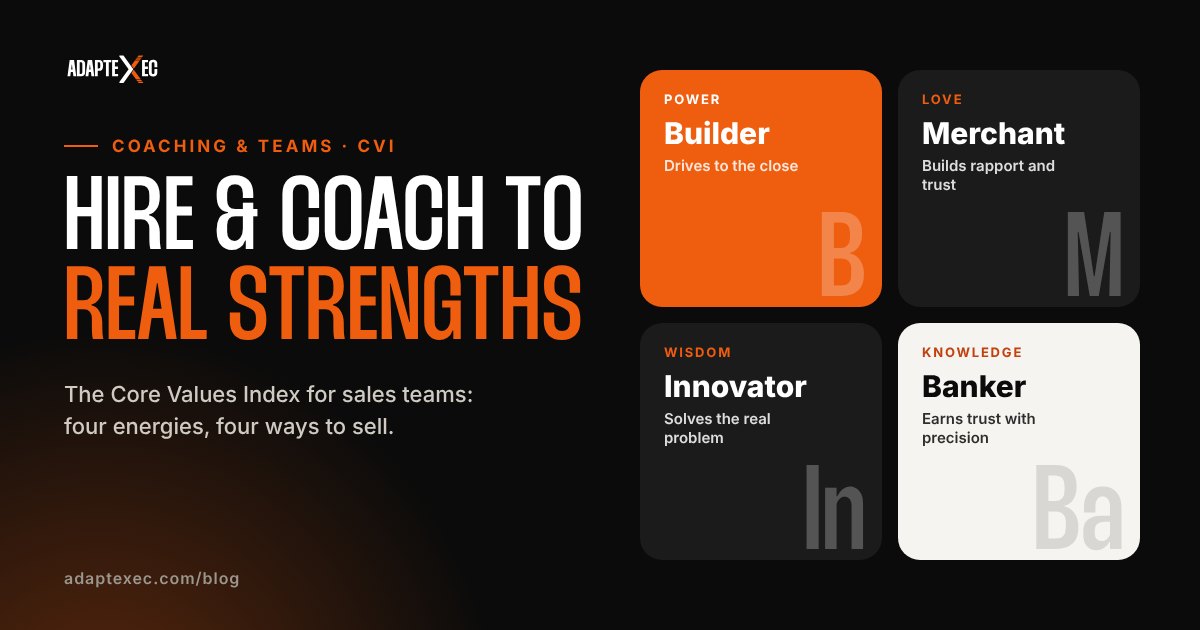
The Core Values Index (CVI) is a short assessment from Taylor Protocols that measures how much of four core values each person carries: Builder, Merchant, Innovator and Banker. For a sales team, it’s useful in three places: hiring (as one input on role fit), coaching (helping each rep sell from their natural strengths) and selling (reading how a buyer is likely to decide). It takes about 8 to 10 minutes per person.
This guide is for sales managers and owners who want a better way to hire, coach and pair their people than gut feel. Adam Neuerburg, our founder, is a Certified CVI Coach through Hardwired Coaching, and because we also build custom CRMs, we see how wiring shows up in real pipelines. We’ll explain what the CVI is, how each energy tends to sell, how to use it responsibly in hiring, and how to roll it out to a team.
Key takeaways
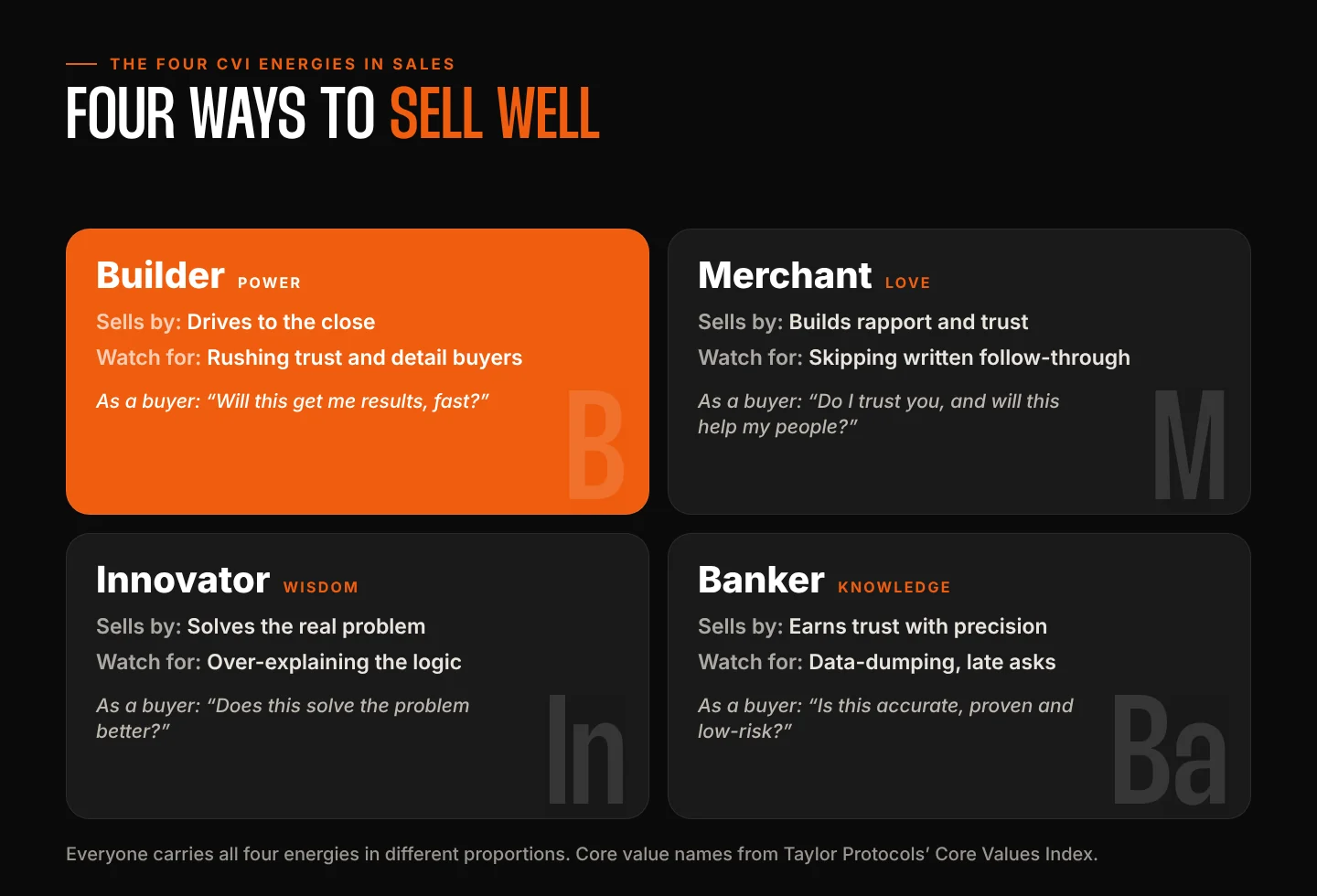
- Everyone carries all four energies in different proportions. Most people lead with one or two.
- Each energy sells differently. Builders push to the close, Merchants build trust, Innovators solve the problem, Bankers prove it.
- Use the CVI as one hiring input, alongside structured interviews, experience and references. Never as a cutoff on its own.
- Most reps sell the way they like to buy. Knowing their own wiring shows them which buyers they’re losing.
- The payoff comes after the debrief, when the language shows up in one-on-ones, deal reviews and your CRM.
What the Core Values Index measures
Taylor Protocols, which created and owns the Core Values Index, describes it as a measure of a person’s innate core values rather than personality preferences or behavioral styles. Its position is that these values stay the same over a lifetime, which is why it reports 97.7% repeat reliability on its official site (Core Values Index by Taylor Protocols). That reliability figure is the publisher’s own. It describes how consistently the same person scores over time, not how well the CVI predicts sales results.
The format is simple. You choose words from groups of four, picking the two that resonate most with you. There are no right or wrong answers. The result shows your score for each of the four core values, your dominant and secondary values, and your overall proportion. The full assessment with a 17-page report is sold on the official site, and Taylor Protocols says more than 1.3 million assessments have been taken.
| Energy | Core value | How Taylor Protocols describes it |
|---|---|---|
| Builder | Power | Values action and results, straightforward speech and bottom-line thinking |
| Merchant | Love | Builds meaningful connections and inspires others toward a shared vision |
| Innovator | Wisdom | Sees how things work and finds better ways to do them |
| Banker | Knowledge | Knows the facts through research, measurement and careful analysis |
Summarized from the official Core Values Index site, accessed October 2026.
What the CVI is not: a skills test, an IQ test or a guarantee that someone will hit quota. It tells you how a person is wired to create value. Whether they’ve learned your product, your market and the discipline of fast, consistent follow-up is a separate question.
How each energy tends to sell
Every one of the four energies can sell well. They just win in different ways and stall in different places.
Builder sellers
Builders drive to the close and keep deals moving. They’re comfortable asking for the decision and they don’t let a stalled deal sit. Watch for: rushing Merchant buyers who need trust first and Banker buyers who need detail first.
Merchant sellers
Merchants build rapport fast and tell a compelling story. Referrals and long relationships tend to follow them. Watch for: skipping the details and written follow-through that Banker buyers need, and over-promising in the moment.
Innovator sellers
Innovators diagnose the real problem and design a better solution, which makes them strong in complex or technical sales. Watch for: over-explaining the logic to a Builder who wanted the bottom line two minutes ago.
Banker sellers
Bankers earn trust through preparation and accuracy. Buyers who hate surprises love them. Watch for: data-dumping on Builders and Merchants who want the headline, and waiting too long to ask for the business.
Hiring: use the CVI as one input, not a filter
The CVI is most valuable in hiring when it helps you have a better conversation, not when it makes the decision for you. Start with the role, not the candidate. A field rep who prospects cold every day, an account manager who keeps 80 clients happy and a sales engineer who designs complex proposals are three different jobs.
- Define what the role really demands. Write down the daily activities, the hardest part of the job and what success looks like at 90 days.
- Interview everyone the same way. Use structured questions and score them against the role, so the assessment doesn’t become a shortcut.
- Use the CVI to shape the conversation. If a strongly Banker candidate is applying for a high-volume prospecting role, ask how they’ve handled that pace before. Don’t assume.
- Check experience and references. Wiring explains how someone tends to work. Track record shows what they’ve actually done.
- Plan onboarding around the profile. A Merchant hire and a Banker hire need different first-month coaching.
Coaching each rep to their real strengths
Generic sales training assumes every rep should sell the same way. CVI-based coaching starts from how a rep is wired and builds the missing skills on top. A few patterns we see:
| Rep leads with | Lean into | Coach toward | How to manage them |
|---|---|---|---|
| Builder | Closing, pace, urgency | Slowing down for trust and detail buyers | Clear goals, real authority, short check-ins |
| Merchant | Rapport, referrals, storytelling | Written follow-up, accurate notes in the CRM | Connect personally first, share the why |
| Innovator | Discovery, complex solutions | Shorter pitches, asking for the decision | Bring problems, explain the reasoning behind targets |
| Banker | Preparation, proposals, accuracy | Headlines first, earlier asks | Clear expectations, time to prepare, no surprises |
The best one-on-ones change shape for each person. A Builder rep wants three bullet points and a target. A Banker rep wants the plan in writing a day ahead. Same manager, same goals, different delivery.
Selling to the way buyers are wired
Buyers carry the same four energies. You can’t hand a prospect an assessment, but you can listen for cues: how fast they talk, what they ask about first, and whether they want the story, the logic, the data or the bottom line.
| Buyer | What they’re really asking | Open | Close |
|---|---|---|---|
| Builder | Will this get me results, fast? | Lead with the outcome in one or two sentences | Ask for the decision; make next steps simple |
| Merchant | Do I trust you, and will this help my people? | Connect first; ask about their vision and team | Invite them into the vision; follow up personally |
| Innovator | Does this solve the problem better? | Start with the problem and ask good questions | Summarize the reasoning and give them room |
| Banker | Is this accurate, proven and low-risk? | Come prepared with an agenda and specifics | Give a written plan and time to review |
From our CVI for teams and sales playbook, which also covers presenting and handling objections for each buyer type.
One caution: buyer “reads” are educated guesses, not labels. Treat them as a starting hypothesis and adjust as you learn more about the person.
Building a balanced sales team
Once everyone on the team has taken the CVI, plot the mix. Teams tend to hire people like their leader, so a Builder-led team is often short on Banker and Innovator energy, and it shows: deals close fast, but proposals have errors and complex accounts churn.
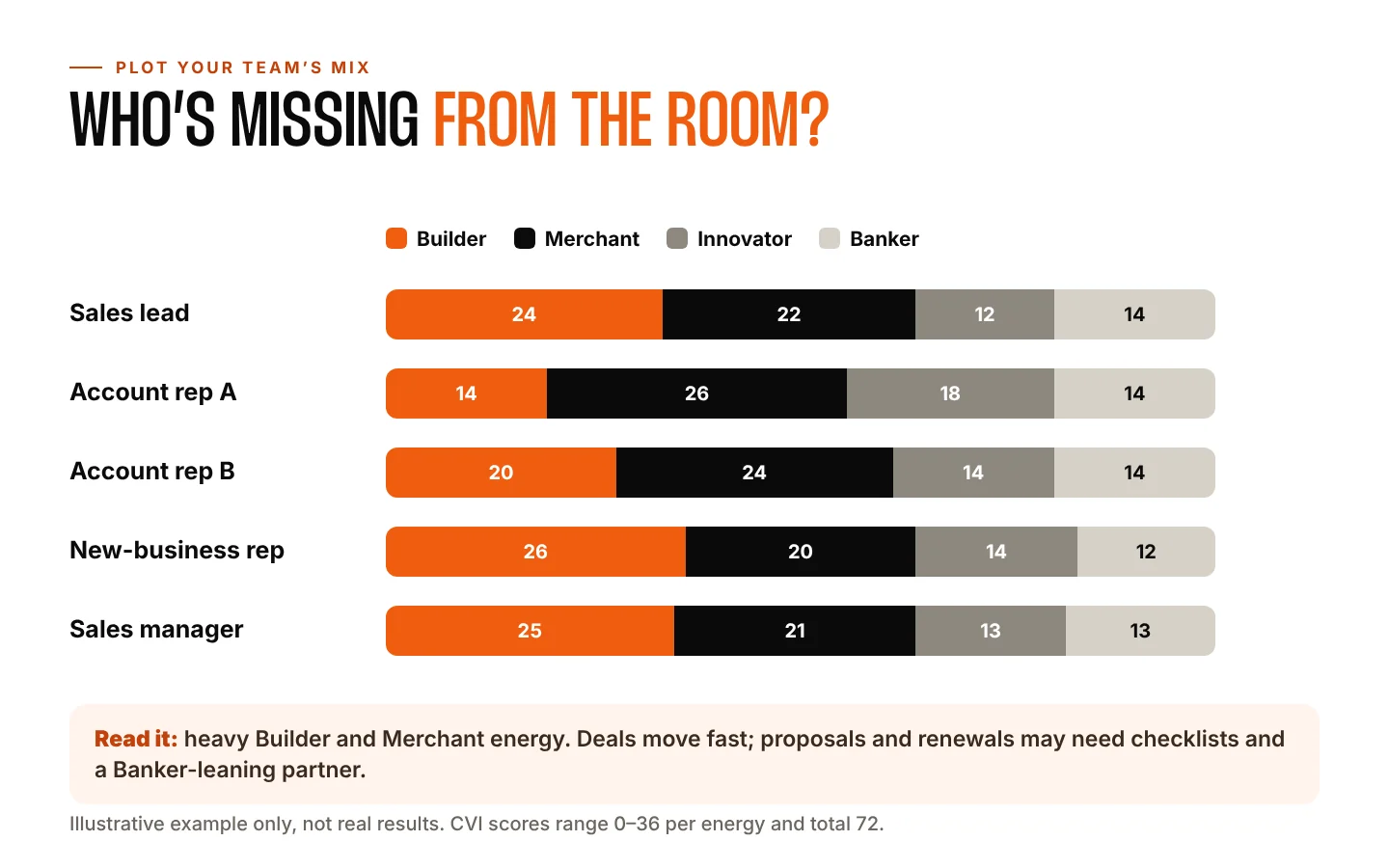
- Match roles to energy where you can. New-business hunting often suits Builder and Merchant energy; account management, renewals and proposal work often suit Banker and Innovator energy. People can succeed outside their lean, but it costs them more effort.
- Pair complementary reps on big deals. A Merchant who owns the relationship plus a Banker who owns the proposal is a strong team.
- Cover your gaps in process. If nobody on the team leads with Banker energy, build checklists and CRM reminders that do that job.
Rolling out the Core Values Index to your sales team
- Leaders go first. Managers take the assessment and debrief before the team does. It builds trust and shows the leader’s own blind spots.
- Everyone takes it. About 8 to 10 minutes each, online.
- One-on-one debriefs. A Certified CVI Coach walks each person through their results, strengths and conflict tendencies.
- A team workshop. See the whole team’s mix, practice selling to each buyer type and agree on how you’ll use the shared language.
- Put it to work. Use it in one-on-ones, deal reviews and pairing decisions. Revisit after 90 days to see what changed.
How AdaptExec brings CVI to sales teams
Our CVI coaching covers individual debriefs, team workshops, leadership coaching and sales training by core values. Adam is a Certified CVI Coach through Hardwired Coaching (you can read more about Adam), and we travel to teams across the country for in-person sessions, with individual debriefs available virtually.
What makes our approach different is the second half: we also build custom CRMs. That means we can carry what your team learns into the system they use every day, with leads tagged by likely buyer type, suggested next steps for each energy and dashboards that show who connects best with whom. If you’re weighing whether a custom CRM is worth it at all, start with our custom CRM vs. HubSpot comparison. Every engagement starts with a free consultation, and nothing requires a long-term contract.
Core Values Index for sales teams FAQ
What is the Core Values Index?
The Core Values Index is an assessment created by Taylor Protocols that measures four core values: Builder (Power), Merchant (Love), Innovator (Wisdom) and Banker (Knowledge). Everyone carries all four in different proportions, and the result shows your dominant and secondary values.
How long does the CVI take?
The official site says 8 to 10 minutes. You pick two words from each group of four, and there are no right or wrong answers.
Can we use the CVI to hire salespeople?
Many organizations use CVI insights to understand role fit, but use it as one input alongside structured interviews, experience and references, not as a pass/fail filter. The EEOC expects any test used in hiring to be job-related and validated for its purpose.
How is the CVI different from DISC or Myers-Briggs?
Taylor Protocols positions the CVI as measuring innate core values that don’t change over time, rather than personality preferences or behavioral styles that can shift. In practice, teams use the CVI to talk about how people create value, communicate and handle conflict.
What’s the best CVI type for sales?
There isn’t one. Builders tend to excel at closing, Merchants at relationships, Innovators at complex problem-solving and Bankers at precision and trust. The best teams combine energies and match roles to strengths.
Sources
- Core Values Index (Taylor Protocols): The Official Home of the CVI, accessed October 2026.
- U.S. EEOC: Employment Tests and Selection Procedures, accessed October 2026.