
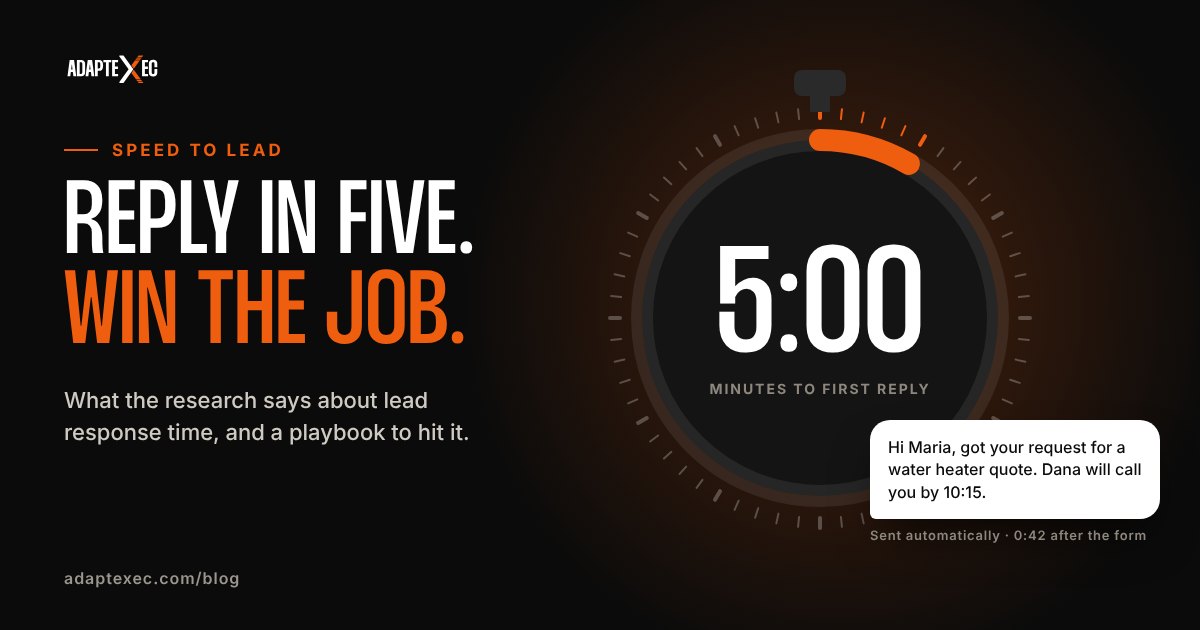
Speed to lead is the time between a new inquiry arriving and your business making real contact. It matters because interest fades fast: in the original 2007 Lead Response Management study, the odds of reaching a web lead were 100 times higher when the call came within 5 minutes instead of 30, and the odds of qualifying the lead were 21 times higher. Most businesses are nowhere near that. The fix is less about hustle and more about a simple system: instant acknowledgment, a fast human reply, and follow-up that doesn’t depend on memory.
We build websites and CRMs for service businesses in the Phoenix Valley, and slow replies are the leak we find most often. This guide explains what the research actually says (and what it doesn’t), then gives you a five-minute response playbook you can set up whether you use our tools or not.
Key takeaways
- The famous “5 minutes” number is real, but it comes from a 2007 study of 15,000+ web leads at six companies, measuring contact and qualification, not closed sales.
- Most businesses are slow. In HBR’s audit of 2,241 U.S. companies, only 37% responded within an hour and 23% never responded.
- Acknowledge in seconds, talk in minutes. An instant auto-reply holds the lead; a human call or text within five minutes wins it.
- Follow-up is part of speed. Leads that don’t answer the first time need a scheduled sequence, not good intentions.
- Measure it. If you don’t track time to first reply, you don’t know your number.
What the speed-to-lead research actually says
Two pieces of research sit behind almost every speed-to-lead claim you’ll see. They’re worth knowing accurately, because the numbers get stretched a lot online.
The 2007 Lead Response Management study
Dr. James Oldroyd, then at MIT’s Sloan School of Management, worked with InsideSales.com to analyze three years of data: more than 15,000 web-form leads and over 100,000 call attempts across six companies. The findings were presented in October 2007 (Lead Response Management study, PDF):
- The odds of contacting a lead were 100 times higher at 5 minutes than at 30 minutes, and dropped 5 times between 5 and 10 minutes.
- The odds of qualifying a lead were 21 times higher at 5 minutes than at 30, and dropped 4 times between 5 and 10 minutes.
- Contact odds fell more than 10-fold over the first hour.
Two honest caveats. First, the study measured contact and qualification, not closed deals; the authors say it didn’t address close rates. Second, it’s correlational and covers web leads at a handful of companies. It doesn’t prove that calling in four minutes instead of six will double your revenue. It does show a steep, early drop that later research kept confirming.
The 2011 Harvard Business Review audit
Oldroyd, Kristina McElheran and David Elkington followed up in “The Short Life of Online Sales Leads” (HBR, March 2011). They sent test web leads to 2,241 U.S. companies and timed the response. As summarized by SmartCompany:
- 37% responded within an hour, 16% within 1 to 24 hours, 24% took longer than 24 hours, and 23% never responded.
- Among companies that responded within 30 days, the average response time was 42 hours.
- In a separate analysis of 1.25 million leads at 42 companies, firms that tried to contact a lead within an hour were nearly 7 times as likely to qualify it (have a meaningful conversation with a decision maker) as firms that tried even an hour later, and more than 60 times as likely as firms that waited 24 hours or more.
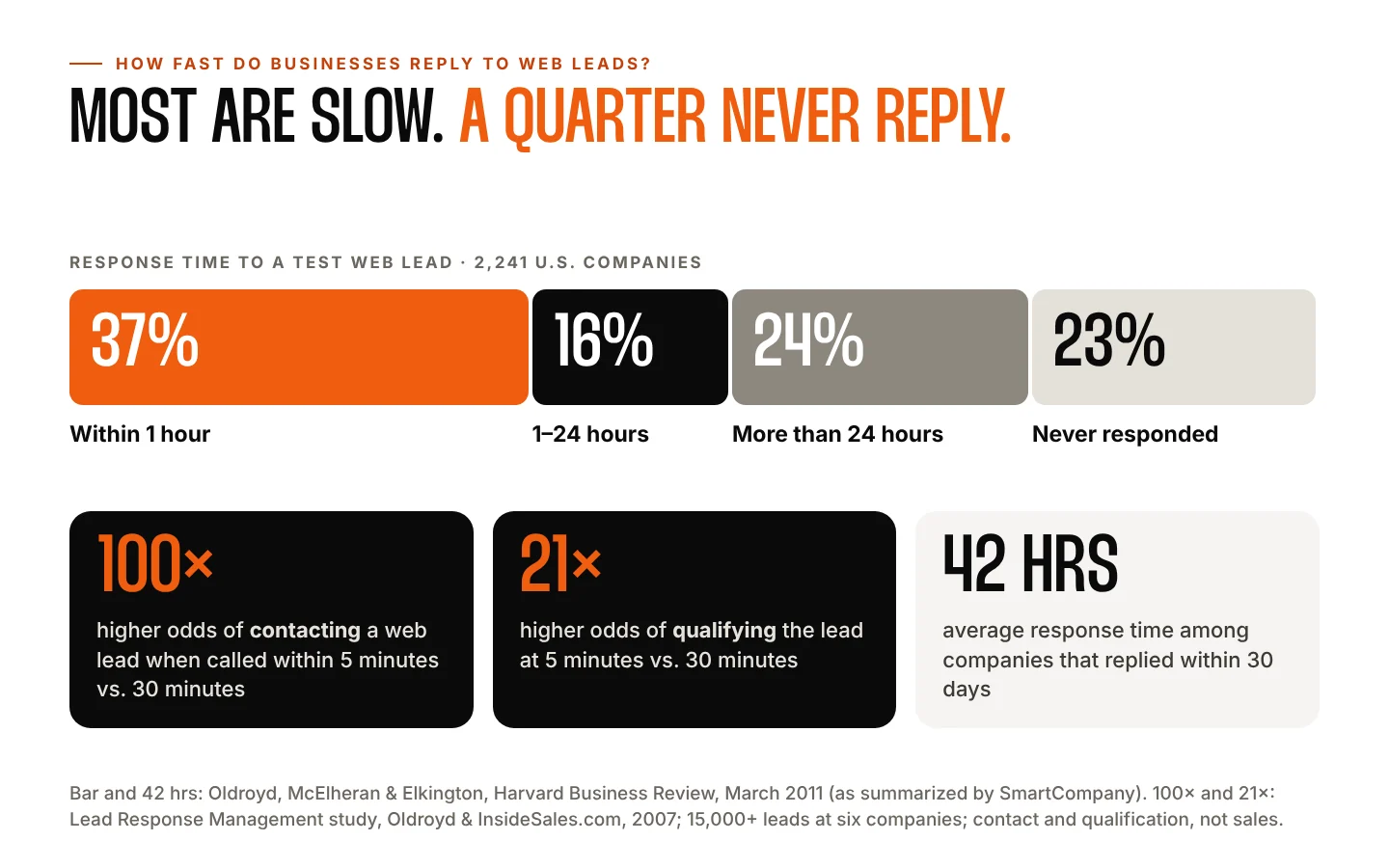
23%
Share of 2,241 U.S. companies that never responded to a test web lead. Being merely “on time” puts you ahead of a big chunk of the market.
Source: Harvard Business Review, March 2011, via SmartCompany
Why replying fast wins more jobs
The research explains the “what.” The “why” is easy to picture if you’ve ever needed a plumber at 7 am.
- People contact several businesses at once. They fill out three forms or call down the list. The first business to have a real conversation usually sets the standard the others are measured against.
- Intent is highest right after the click. They’re thinking about the problem now, with their phone in hand. An hour later they’re in a meeting.
- Speed signals how you’ll treat them as a customer. A fast, friendly reply before the job says a lot about the service after it.
- Slow replies make your marketing more expensive. Every ad dollar and every hour on your website and SEO gets you an inquiry. Letting it go cold wastes the spend that produced it.
Our own list of signs your website is costing you leads puts slow replies and missed calls in the middle for a reason: the site did its job, and the lead still disappeared.
The five-minute response playbook
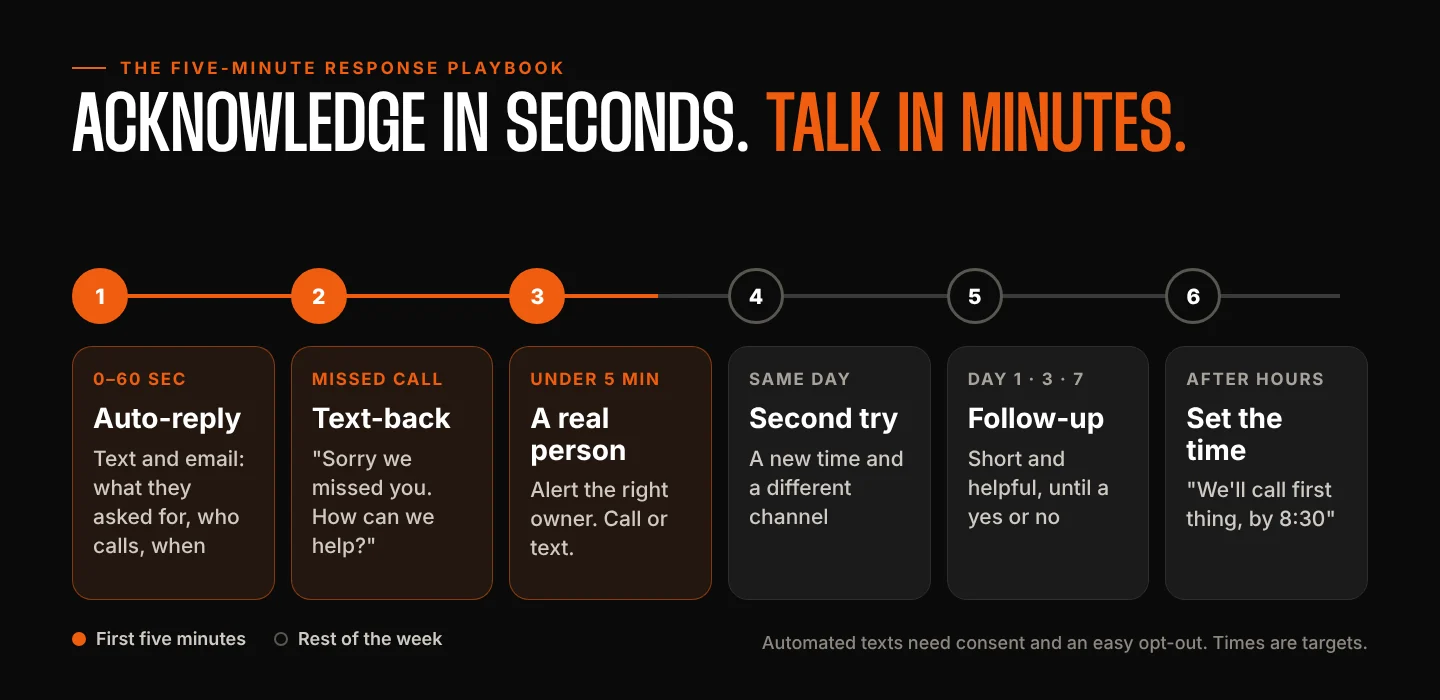
You can’t personally answer every inquiry in five minutes while running a business. You can build a system that gets close. Here’s the sequence we set up for clients, in order.
- 0–60 seconds: automatic acknowledgment. Every form, text and chat gets an instant, human-sounding reply that confirms what they asked for and says when they’ll hear from a person. Include a booking link if you take appointments.
- Missed calls: instant text-back. If a call isn’t answered, send a text automatically: “Sorry we missed you, this is Dana at Copperline. How can we help?” Many callers would rather text than leave voicemail.
- Under 5 minutes: a real person reaches out. During business hours, the right person gets an alert with the lead’s details and calls or texts. Route by service or area so nobody wonders whose lead it is.
- Same day: second attempt. If there’s no answer, try again a few hours later by a different channel.
- Days 1, 3 and 7: scheduled follow-up. Short, helpful messages, not “just checking in.” Stop when they reply or say no.
- After hours: set expectations. The auto-reply says when you’ll call (“first thing tomorrow, before 8:30”) and offers online booking.
The tools that make speed to lead possible
You don’t need a dozen apps. You need a few pieces that talk to each other.
| Building block | What it does | Without it |
|---|---|---|
| Website forms that post to a CRM | Every inquiry lands in one pipeline with its source and a timestamp | Leads scattered across inboxes; no clock on response time |
| Instant auto-reply (text and email) | Acknowledges in seconds, sets expectations, offers booking | Customers keep shopping while they wait |
| Missed-call text-back | Turns a missed call into a text conversation | Callers dial the next business |
| Alerts and routing | Notifies the right person by service, area or schedule | “I thought you had it” |
| Follow-up sequences and tasks | Schedules the next touch until there’s a yes or no | Follow-up depends on memory |
| Response-time reporting | Shows time to first reply by person and source | No idea whether you’re getting faster |
Off-the-shelf CRMs can do much of this with configuration and add-ons. A custom CRM does it the way your team already works, without per-seat fees. If you’re weighing the two, our comparison of custom CRM vs. HubSpot and Salesforce runs the three-year math.
How to measure your speed to lead
Start simple. For the next two weeks, log three timestamps for every inquiry: when it arrived, when you acknowledged it, and when a person actually spoke or texted with them. Then look at:
- Median time to first human contact, during business hours and after hours separately.
- Share of leads contacted within 5 minutes and within 1 hour.
- Leads with no contact at all after 24 hours. This should be zero.
- Response time by source. Website forms, Google Business Profile messages and phone calls often behave very differently.
A CRM that timestamps everything will do this for you. A spreadsheet works for two weeks. Either way, the first measurement is usually the most eye-opening part of the whole exercise.
Common speed-to-lead mistakes
- Fast but robotic. An instant reply that says “Your message has been received” does little. Use their name, mention what they asked about, and say who will contact them and when.
- Speed without routing. Alerts that go to everyone often get handled by no one. Assign an owner per lead.
- Giving up after one try. The 2007 study found contact odds kept falling with time, so persistence early matters. A no-answer is not a no.
- Over-automating. Automation should get you to a human conversation faster, not replace it.
- Not fixing the form. If your website form is broken or goes to the wrong inbox, none of this works. Test it monthly.
How AdaptExec helps you reply in minutes
We build the pieces above as one system: websites whose forms land in a CRM, instant replies, missed-call text-back, routing and follow-up reminders, shaped around how your team actually works. Some clients need the whole thing. Others need one automation added to tools they already have. We’ll tell you which.
- Custom CRMs start around $1,500, and every quote is custom. Design yours first in our free CRM Builder and watch a live mock-up build as you answer.
- You own what we build. No per-user fees, no required monthly plan and no long-term contract.
- See it in action. Our live demo sites (fictional brands, real builds) show booking flows and inquiries landing in a CRM.
Speed to lead FAQ
What is speed to lead?
Speed to lead is how long it takes your business to make meaningful contact with a new inquiry, measured from the moment the form, call or message arrives. Most teams track time to first human contact, not just time to an automated reply.
Is the 5-minute rule real?
It comes from real research. The 2007 Lead Response Management study of more than 15,000 web leads found contact odds were 100 times higher at 5 minutes than at 30. It measured contact and qualification, not closed sales, so treat 5 minutes as a strong target rather than a magic number.
What is a good lead response time for a small business?
Aim for an instant automated acknowledgment and a human call or text within 5 minutes during business hours, and certainly within the hour. After hours, set a clear expectation and follow through first thing the next morning.
How can I respond fast if I’m on a job all day?
Use automation to cover the first minute (auto-reply, missed-call text-back, booking link) and route alerts to whoever is free. Even a short text from the field (“On a job, calling you by 3”) counts as fast contact.
Do I need a CRM to improve speed to lead?
Not to start; a shared spreadsheet and phone alerts can work for a small team. But a CRM makes it consistent: every lead timestamped, assigned and followed up automatically. That’s usually when response times stop depending on who’s having a busy day.
Sources
- Lead Response Management study, Dr. James Oldroyd and InsideSales.com, presented October 2007 (PDF copy).
- Harvard Business Review: The Short Life of Online Sales Leads, Oldroyd, McElheran and Elkington, March 2011.
- SmartCompany: Are you letting online leads go cold?, July 2011 (summary of the HBR findings).