
![Museum-style exhibit of near-identical bad SEO blog posts titled Home Builder [Town], labeled Exhibit A: 4,149 blog posts](https://adaptexec.com/wp-content/uploads/2026/10/bad-seo-blog-posts-exhibit-a-museum.jpg)
What do bad SEO blog posts look like? Usually like this: hundreds of near-identical pages built from one keyword, one town name and a rotating slogan. Our Exhibit A is a real small-business website, a mountain-town home builder, with 4,149 “articles” in its sitemap. 78% of their URLs contain the same town name, and none of the 40 we sampled has a single link in its body copy. Google’s spam policies have names for this: scaled content abuse, doorway abuse and keyword stuffing. Welcome to the museum. Please keep your arms inside the ride.
A quick word before the tour. This is a teardown of tactics, not people. We aren’t naming the business, the town or anyone involved, and every screenshot is redacted. The project photos on the site are lovely, and nothing here says a thing about how these folks build houses. If anything, the owner is the likely victim: somebody sold them a “blog SEO” playbook, and this is what that playbook looks like after a few years on autopilot. I’ve watched a business pay around $4,000 a month for content like this. So if you recognize your own website in the exhibits, don’t panic. There’s a fix at the end, right next to the gift shop.
Key takeaways
- Volume isn’t a strategy. 4,149 pages that say the same thing count as one idea, and Google calls mass-produced pages like these scaled content abuse.
- City-plus-keyword permutations are doorway pages. Rearranging “home builder [Town]” 600 times doesn’t make 600 useful pages.
- Repeating a phrase until it sounds unnatural is keyword stuffing, straight from Google’s own examples.
- Nobody proofreading is a security risk too. When nobody reads the blog, nobody notices a page that shouldn’t be there.
- The fix is fewer, better pages: one strong page per service, real projects, internal links, and a well-run Google Business Profile.
Welcome to the museum of bad SEO blog posts
Every museum tour starts in the lobby, and ours starts in the sitemap. A sitemap is the list a website hands Google that says “here’s everything I’ve got.” Exhibit A’s list is a long one: 4,149 article URLs across five XML sitemaps, plus an HTML sitemap page that displays all 4,149 titles on a single page. Scrolling it feels like reading the terms and conditions of a very enthusiastic hostage.
Here are the first 22, with the business and place names blacked out. Read a few out loud. Feel the rhythm.
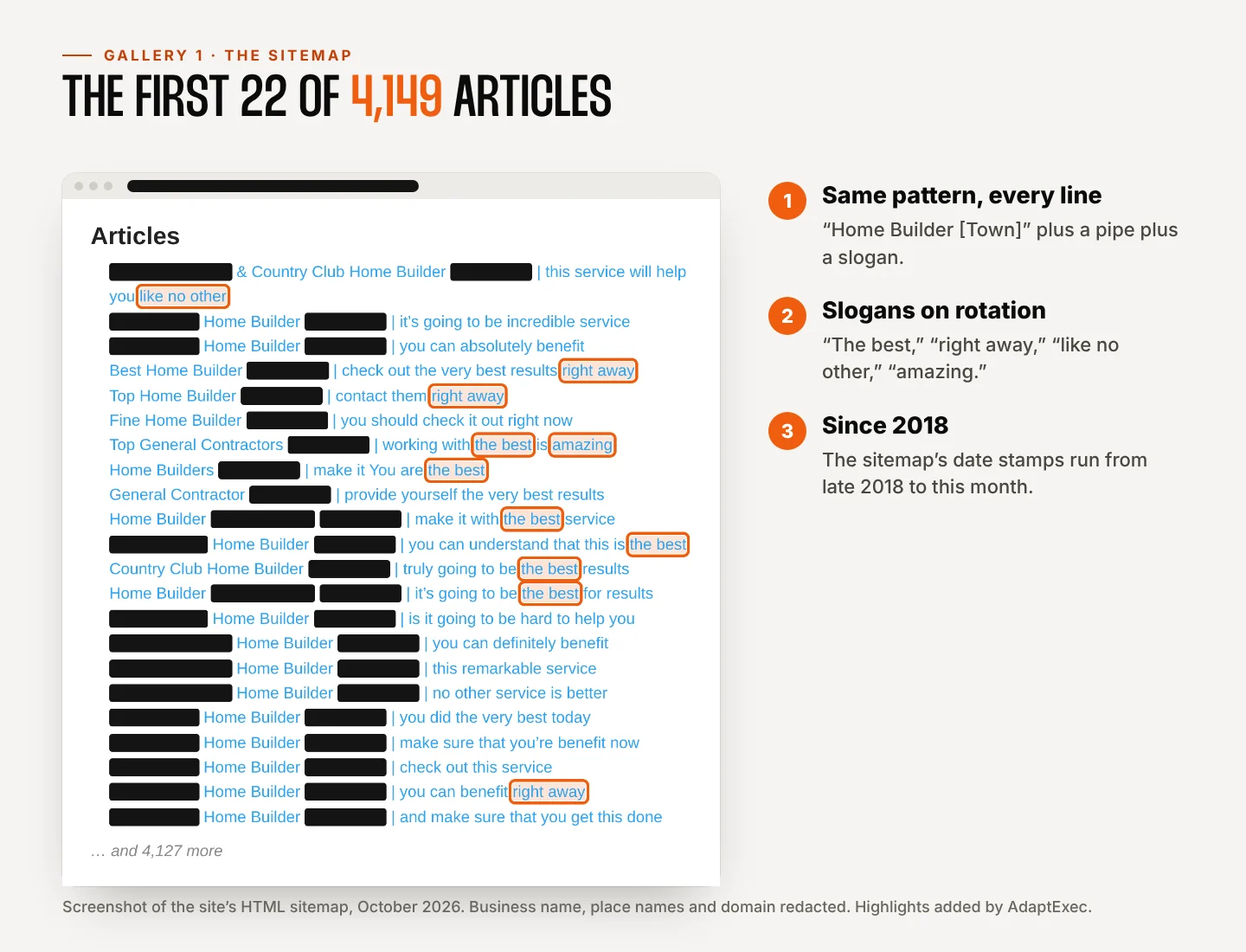
Every title follows one formula: a keyword, a town, a pipe, and a slogan pulled from what I can only assume is a spreadsheet column labeled “adjectives.” “This service will help you like no other.” “Check out the very best results right away.” “Make it You are the best.” That last one has a capital Y, which I respect, because it’s the only decision on the page that looks like a human made it.
The date stamps in the sitemap run from late 2018 to this month. That’s not a campaign. That’s a lifestyle.
Exhibit A: the Permutation Wing
If you strip the slogans off the URLs and keep the keyword at the front, the whole collection boils down to about 13 phrases. Here’s how many articles each one got.
![Bar chart of 4,149 articles grouped by keyword phrase, from 689 for [Town] new homes to 90 for home builder [Town], with 614 articles using one phrase in three word orders](https://adaptexec.com/wp-content/uploads/2026/10/keyword-permutation-doorway-pages-chart.webp)
Look at the orange bars. “[Town] home builder,” “home builders [Town]” and “home builder [Town]” are the same three words wearing different hats, and together they account for 614 articles. The leader, “[Town] new homes,” has 689 all by itself.
The deeper you go, the better it gets:
- Some slugs are just the bare keyword, and WordPress, sensing a duplicate, politely added a number. One phrase exists as a page, then
-2,-3, and on up to-12. There is a page called, essentially, “home builders [Neighboring Town] 12.” I need you to sit with that. - Seven different URLs include “super-amazing.” Four end in “we-are-so-good.”
- One slug misspells the very keyword it exists to rank for. Another glues the town name to the next word, so it reads like “[Town]perks.”
Google’s spam policies describe doorway abuse as pages created to rank for specific, similar search queries, and list as an example pages “targeted at specific regions or cities that funnel users to one page.” That’s this wing, almost word for word. Every one of these pages exists to catch a slightly different search and then point you at the same phone number.
Exhibit B: the Right Now Room (keyword stuffing examples)
Let’s step inside one of the articles. This is one of the 4,149, picked because its title, “make it You are the best,” spoke to me.
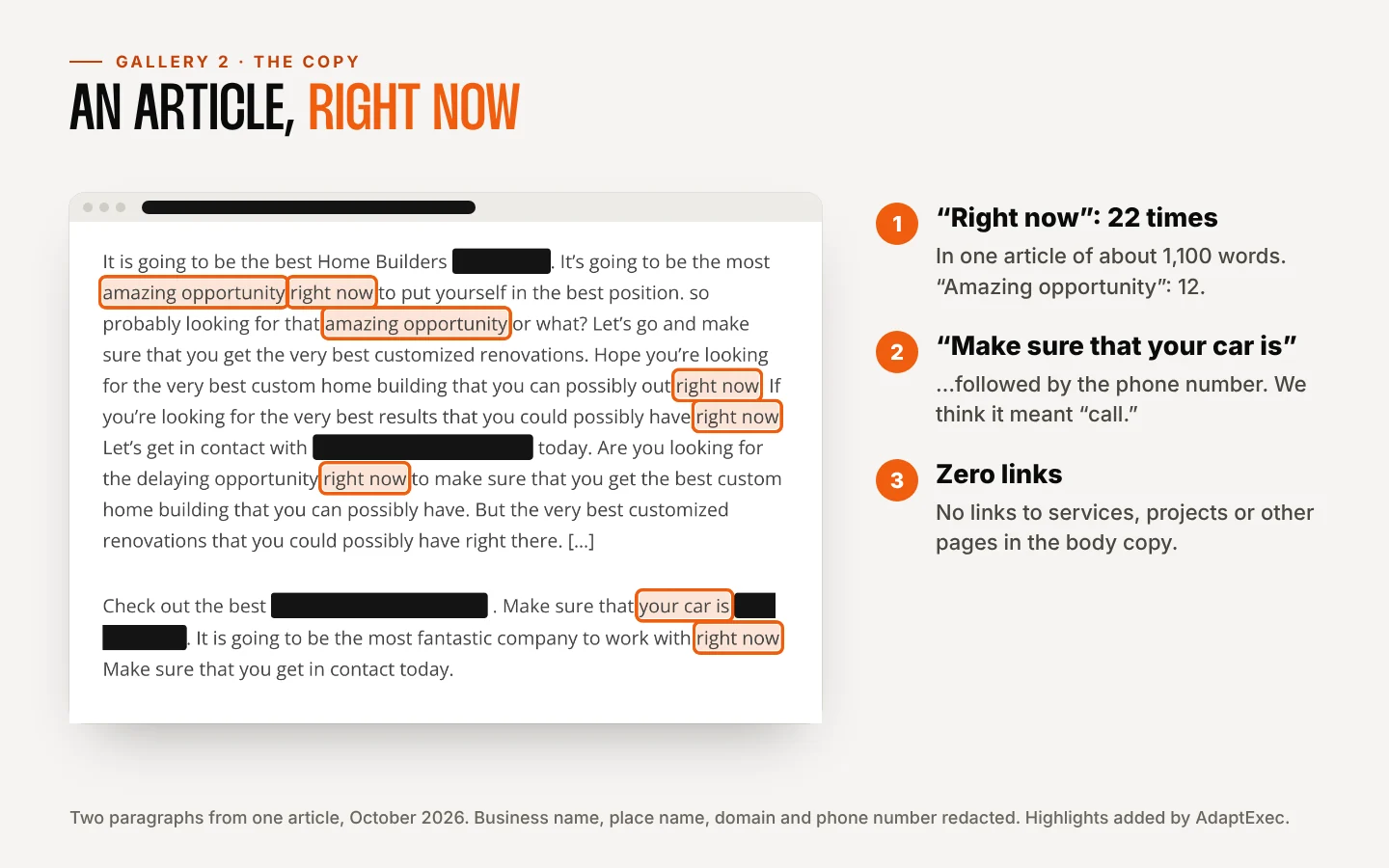
In about 1,100 words, the phrase “right now” appears 22 times. “Amazing opportunity” shows up 12 times. The article is so urgent it never gets around to saying anything. It’s a car alarm in paragraph form.
Then, in paragraph five, it introduces the business’s phone number with the words “Make sure that your car is.” We think it meant “call.” We can’t be sure. Nobody involved seems sure either.
Google’s keyword stuffing policy lists, as an example, “repeating the same words or phrases so often that it sounds unnatural.” You could frame this page and hang it next to that sentence.
The gift shop has more souvenirs:
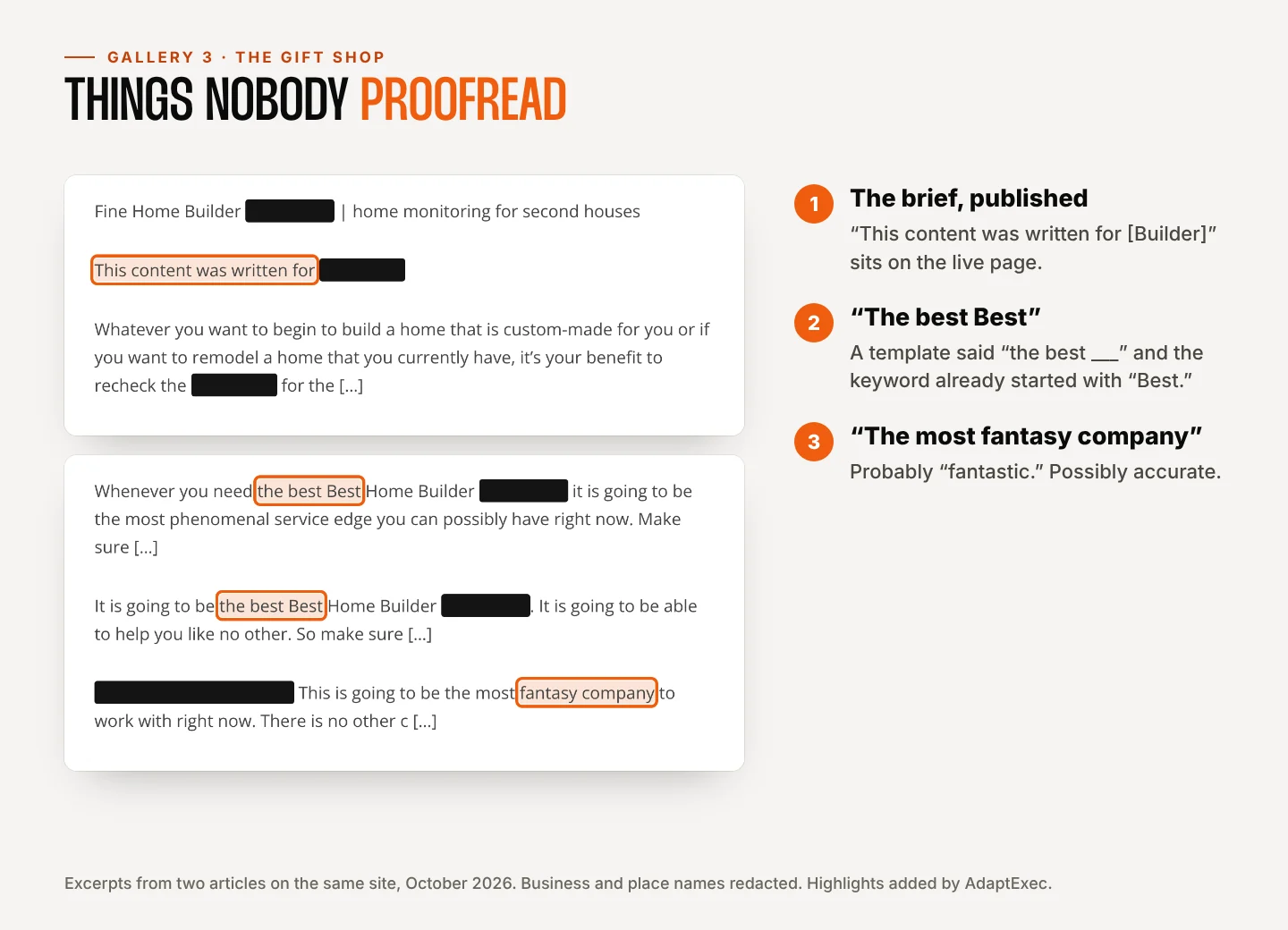
One article opens with the line “This content was written for,” followed by the company name, which reads a lot like a note to the writer that got published along with everything else. Another page, built from a “the best ___” template where the keyword already started with “Best,” offers you “the best Best Home Builder [Mountain Town].” A third promises “the most fantasy company to work with.” Honestly, for a custom home, that might be the pitch.
Other article titles from a random sample of 40, for your enjoyment: “Our Website Is Truly Amazing.” “Our Homes Rock.” And my personal favorite, a construction question for the ages: a how-to on driving nails into “would,” as in the word, not the lumber.
Exhibit C: the 1,000-word quota and the party where nobody talks
Here’s a detail that tells you how this content was ordered. I pulled 40 articles at random. Every one landed between 978 and 1,402 words, with a median of about 1,075. That isn’t a coincidence. That’s a word-count quota, and it’s the most consistent thing on the site.
Google’s own guide to helpful content lists “writing to a particular word count” as a warning sign, then adds, in a rare moment of Google sass: “(No, we don’t.)” They do not have a preferred word count. Somebody was paying for words that Google never asked for.
And the links. Across the 40 random articles, plus the seven I picked by hand, the body copy contained zero links. Not to the services page, not to a project, not to each other. Google’s link best practices say every page you care about should have a link from at least one other page on your site. These 4,149 pages are standing in the same room, wearing the same outfit, and refusing to make eye contact. Two articles I checked even share the same paragraph structure, down to a fifth paragraph that starts with “Check out the best” and the domain name.
Exhibit D: the back room nobody checks
The last stop is behind a velvet rope. The site’s blog categories are named after keywords, 22 of them, and the HTML sitemap shows every one of them empty except one, called “Resettools.” Inside it sits a single post, published in July of this year, whose title advertises a “Cracked” copy of professional audio software for Windows 10. The page lists license key variations and comes with a box asking you to “Verify.”
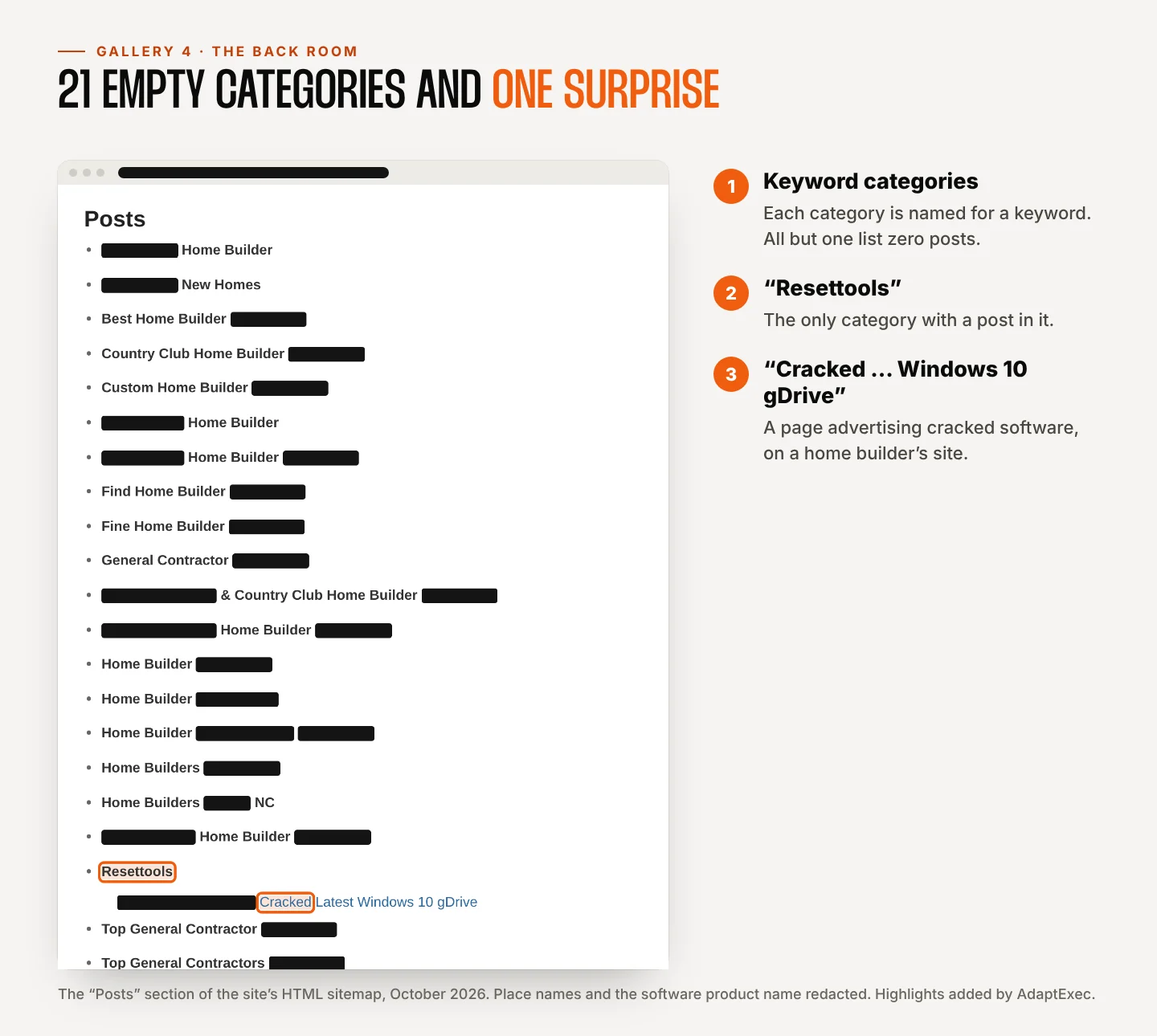
I’m not going to guess how it got there. A page like that on a home builder’s website is the kind of thing that usually means a site was compromised or nobody’s watching. Google’s spam policies have a whole section on hacked content, and it’s a section you don’t want to be featured in.
This is the real cost of a blog on autopilot. When thousands of pages exist only for robots, no human reads them, and when no human reads them, no human notices the one page that really shouldn’t be there.
Why this SEO playbook fails
The theory behind Exhibit A is simple: more pages that contain the keyword means more chances to rank for the keyword. It made a kind of sense in 2009. Here’s why it doesn’t work now.
- Google names it. Scaled content abuse is Google’s term for generating many pages mainly to manipulate rankings rather than help people, “no matter how it’s created.” Hand-typed, dictated or machine-made, the volume is the problem.
- Google says what happens next. Its spam policies say sites that violate them may rank lower or not appear in results at all, through automated systems and, when needed, a manual action from a human reviewer.
- The good stuff gets buried. A buyer about to spend serious money on a custom home wants to see your projects, your process and your people. Exhibit A has 4,149 pages and none of them is that.
- It reads badly to the humans who do land there. Somebody searching for a builder who lands on “your car is [phone number]” doesn’t think “what an SEO-optimized page.” They think “is this a scam?” and hit the back button.
Google’s helpful content guide puts the alternative simply: create content for people first, by someone with real first-hand experience. A home builder has more first-hand experience than almost anyone. That’s the irony of this whole museum.
What to do instead (the short version)
If you’ve been paying for content like this, here’s the fix, in order. It’s less work than 4,149 articles, I promise.
- Write one great page per service. Custom homes, renovations, additions: one page each, with real photos, your process, rough timelines and the questions customers actually ask.
- Add location pages only where you have local proof. A page for a town should show projects in that town. If you can’t fill it with something real, don’t build it. Our local SEO guide for service-area businesses walks through this.
- Turn real projects into content. One honest project write-up with photos, the challenge and the result beats 400 slogans. It’s also the only kind of blog post a future client will finish reading.
- Link your pages together. Projects link to the service they show. Services link to related projects. Every page you care about gets at least one link from another page.
- Put your energy into your Google Business Profile and reviews. For local searches, your profile is what shows up in the map results, and your reviews are what people read there.
- Clean up the old pile. Have someone review the old pages, keep or merge anything useful, and remove or redirect the rest. While they’re in there, have them check for pages and plugins that shouldn’t exist.
How AdaptExec helps
We build and fix small-business websites so they rank for the right reasons. That usually means fewer pages, better pages, real photos and a structure Google can follow. Start with our free SEO checker to see where a page stands. If your site needs a cleanup or a rebuild, our SEO services and website design work are quoted per project, you own everything we build, and there’s no required monthly plan or long-term contract. If you’re budgeting for a rebuild, our guide to what a website costs in 2026 has honest ranges. Or just send us your sitemap and we’ll tell you, kindly, which wing of the museum you’re in.
Bad SEO blog posts FAQ
Is publishing a lot of blog posts bad for SEO?
Not by itself. Publishing lots of thin, near-duplicate posts aimed at keywords is the problem. Google’s spam policies call mass-produced pages made mainly to manipulate rankings “scaled content abuse,” and sites that violate the policies may rank lower or drop out of results. A smaller number of genuinely useful posts does more.
What is an example of keyword stuffing?
Repeating a phrase so often it sounds unnatural, like an article that says “right now” 22 times in 1,100 words, or a page that crams “home builder [Town]” into every other sentence. Google also lists blocks of city names a page is trying to rank for and lists of phone numbers without added value.
Are city or location pages considered doorway pages?
They can be. Google lists pages targeted at specific regions or cities that funnel users to one page as an example of doorway abuse. A location page is fine when it’s genuinely about that place: real projects there, local details, reviews from customers there. Swapping the town name into the same template is the doorway version.
Should I delete old keyword-stuffed blog posts?
Usually, review them first. Keep and improve anything that gets real traffic or answers a real question, merge near-duplicates into one strong page, and remove or redirect the rest. Then make sure your sitemap only lists pages you’d be happy for a customer to read.
Sources
- Google Search Central: Spam policies for Google web search (scaled content abuse, doorway abuse, keyword stuffing, hacked content), accessed October 2026.
- Google Search Central: Creating helpful, reliable, people-first content, accessed October 2026.
- Google Search Central: SEO link best practices, accessed October 2026.
- Exhibit A data: the subject site’s public XML and HTML sitemaps and a random sample of 40 articles, collected by AdaptExec in October 2026. The site is not named; place names, the business name, domain and phone number are redacted.