
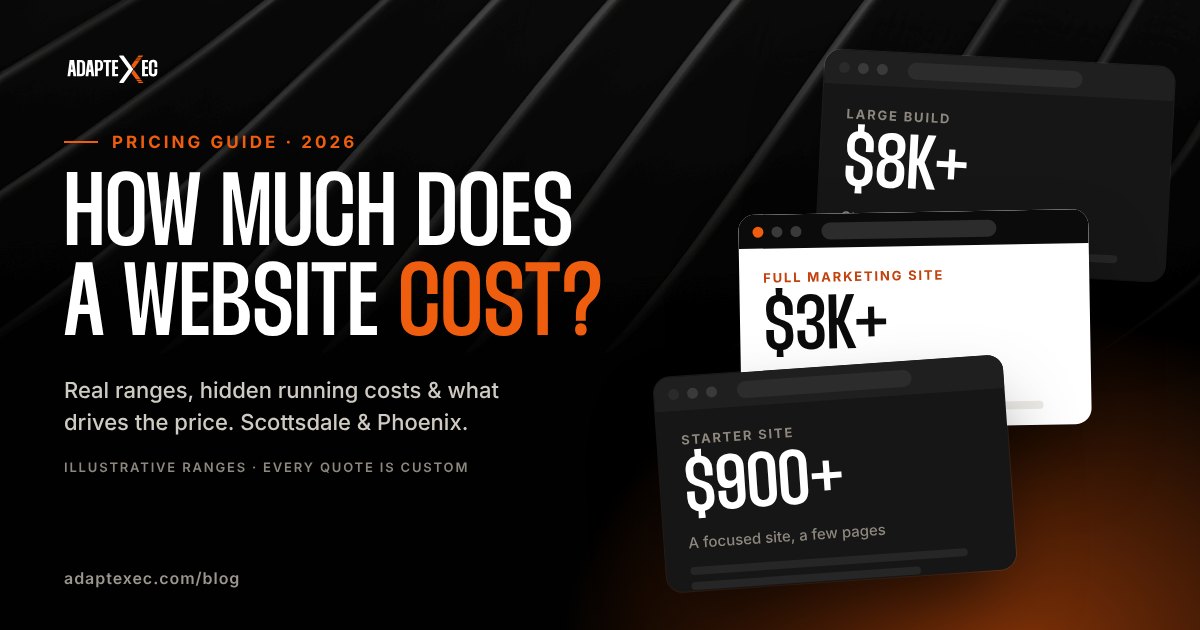
In 2026, a professionally built small business website typically costs $900 to $12,000 from a studio like ours, and larger custom builds can run $30,000 or more. A DIY builder costs less upfront, about $19 to $99 a month on Squarespace’s annual plans, but you trade money for your own time. What you’ll actually pay depends on scope: how many unique page layouts you need, who writes the content, and which features (booking, payments, forms into a CRM) the site has to handle.
We build websites for businesses around Scottsdale, Phoenix and nationwide, and “how much does a website cost?” is the first question almost everyone asks. This guide is the honest answer we give on the phone: real ranges, what moves the price up or down, what it costs to keep a site running, and how to get a quote you can trust.
Key takeaways
- DIY builders run about $19 to $99 a month (Squarespace, billed annually), plus your time.
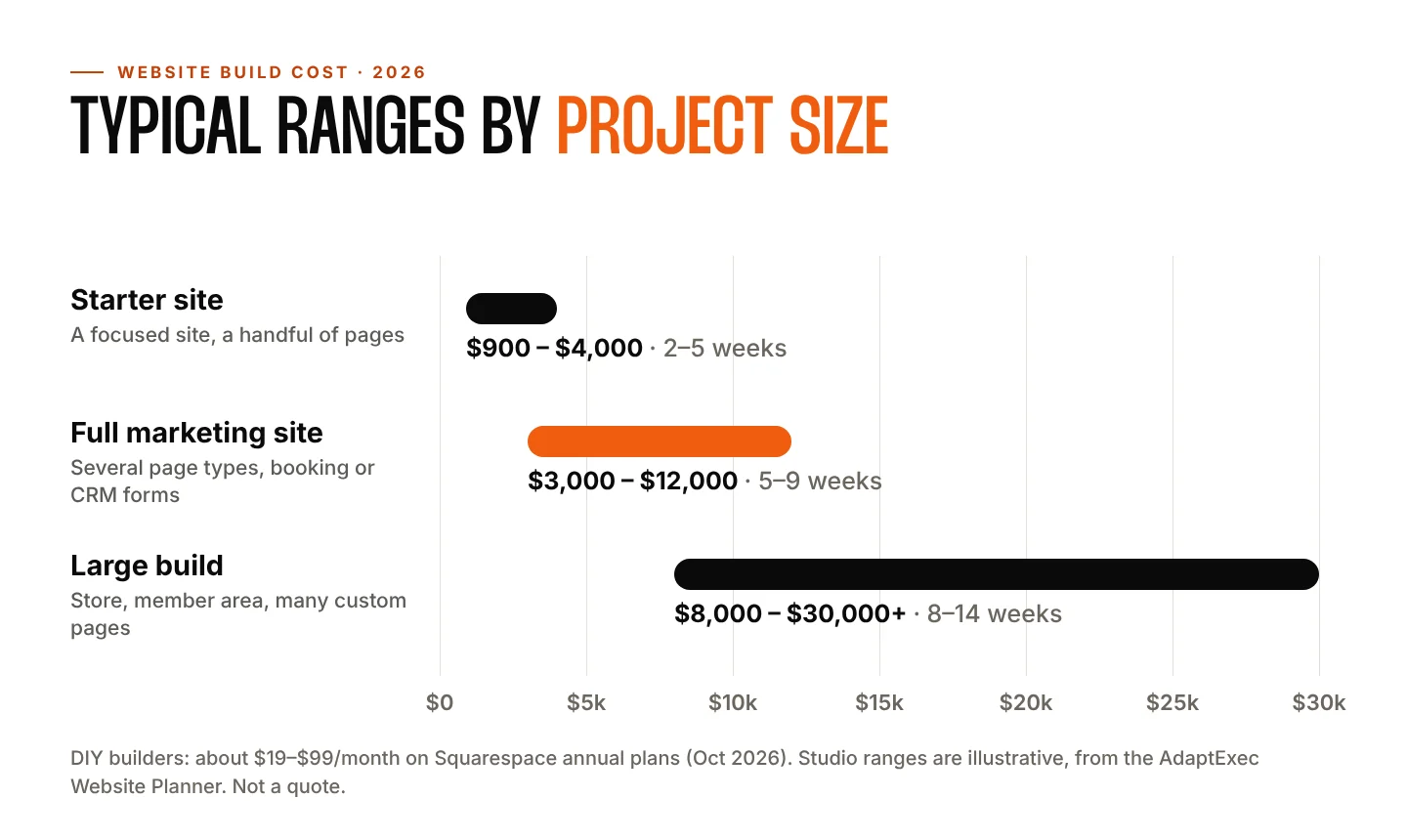
- Custom small business sites commonly land between $900 and $4,000 for a focused starter site and $3,000 to $12,000 for a full marketing site.
- Price follows scope, not page count alone: unique layouts, content, features and integrations matter most.
- Ask every vendor about running costs and ownership before you sign. A low build price with a required monthly contract can cost more over three years.
- At AdaptExec, websites start around $900, every quote is custom, and you own what we build with no required monthly plan.
Website cost ranges in 2026: the short answer
There are four common ways to get a business website, and they price very differently. Here’s how they compare at a glance.
| Option | Typical upfront cost | Ongoing cost | Best for |
|---|---|---|---|
| DIY website builder | $0 plus your time | About $19 to $99/mo on Squarespace annual plans | Very early businesses, simple brochure sites, tight budgets |
| Freelance designer | “From $500 to a couple of thousand dollars,” per Squarespace’s own cost guide | Varies; hosting and updates are often on you | Small sites where you can manage the details yourself |
| Custom studio (like AdaptExec) | Starter sites $900 to $4,000; full marketing sites $3,000 to $12,000 | Hosting and domain; care plans optional | Businesses that need the site to bring in leads and connect to how they follow up |
| Large custom build or agency | $8,000 to $30,000+ | Often a retainer | Online stores, member areas, multiple languages, lots of custom pages |
Squarespace prices are from its pricing page (annual billing) as of October 2026. AdaptExec ranges are the illustrative typical ranges from our free Website Planner, not a quote.
Those ranges overlap on purpose. A “starter” site with an unusually complex booking flow can cost more than a “medium” site with simple pages. That’s why the most useful thing you can do before asking for quotes is understand what actually drives the number.
What actually drives the cost of a website
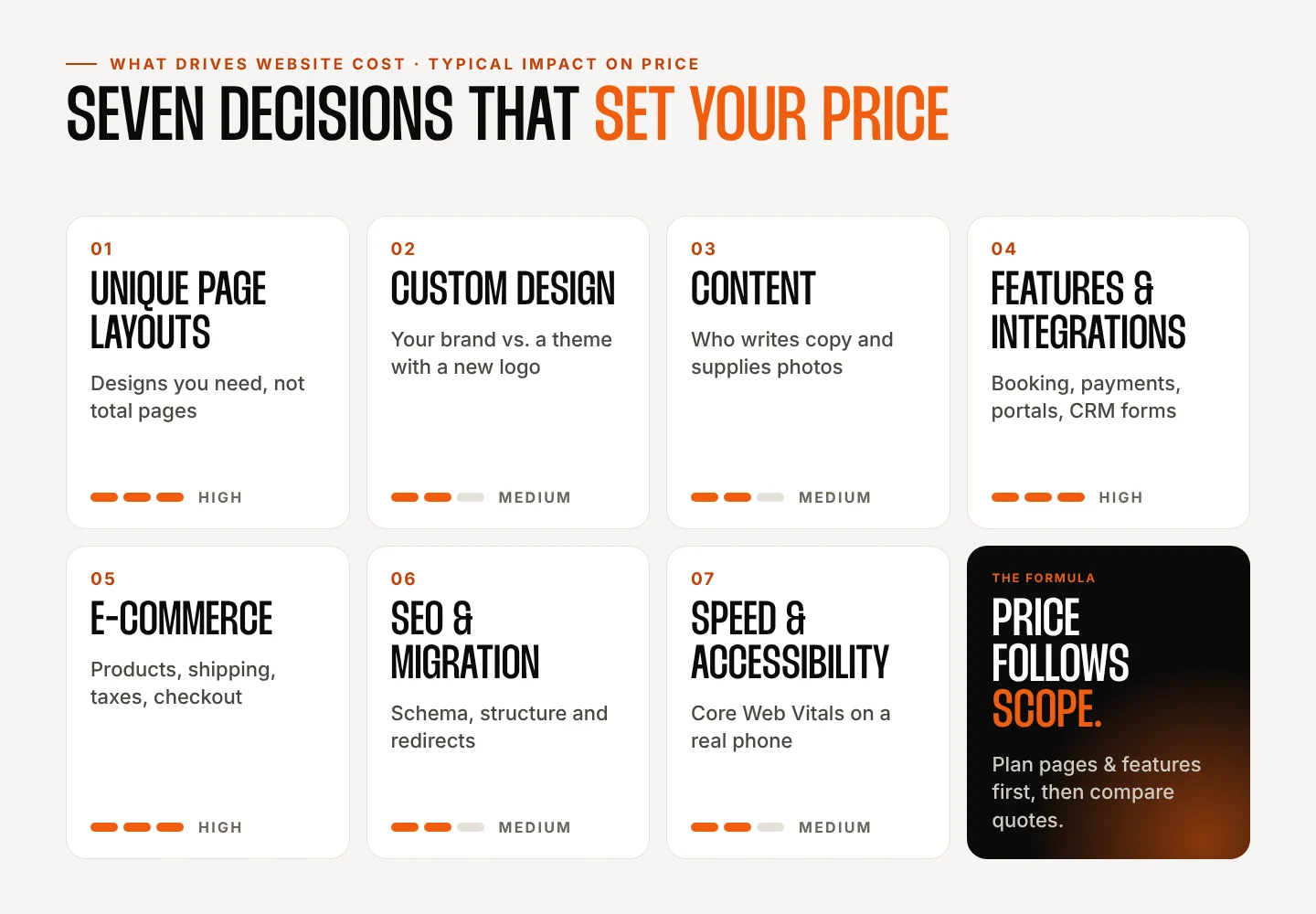
When we scope a site, the price comes down to a handful of decisions. Some of them matter far more than people expect.
1. Unique page layouts, not just page count
Ten service pages that share one well-designed template cost far less than ten pages that each need their own layout. When a quote is “per page,” ask how many unique designs are included. A typical home-services site might need a home page, a service page template, a service-area template, an about page, a gallery and a quote form. That’s six layouts, even if the finished site has thirty pages.
2. Custom design vs. a template
A theme with your logo dropped in is cheaper, but it looks like everyone else using that theme. A custom design is planned around your brand and what you need visitors to do next. If you’re not sure what look fits you, our Website Style Guide lets you compare 18 styles with live previews before you spend anything.
3. Content: words and photos
Content is the most underestimated line item. If you supply finished copy and good photos, the project moves faster and costs less. If the designer has to write service descriptions, interview you, or organize a photo shoot, that’s real work and it should show up in the quote. Either way is fine. Just know which one you’re paying for.
4. Features and integrations
This is where prices separate. A contact form is simple. Online booking, payments, a quote calculator, a client login, or forms that feed a CRM with the lead’s source and next follow-up all take design, development and testing. They’re also usually where a website starts paying for itself, because they turn visitors into booked work.
5. E-commerce
Selling products online adds product pages, inventory, shipping rules, taxes and checkout testing. Even a small store is a different class of project than a brochure site.
6. SEO groundwork and migration
A new site should launch with clean headings, page titles, descriptions and structured data. If you’re replacing an existing site that already ranks, someone also needs to map old URLs to new ones with redirects so you don’t lose traffic. Skipping that step is one of the most expensive “savings” in web design.
7. Performance and accessibility targets
Google’s Core Web Vitals give clear targets for a good experience: Largest Contentful Paint within 2.5 seconds, Interaction to Next Paint of 200 milliseconds or less, and Cumulative Layout Shift of 0.1 or less, measured at the 75th percentile of real visits (web.dev). Hitting those on a phone takes deliberate work: compressed images, lean code and careful layout. It’s worth paying for, and worth asking about.
The running costs most quotes leave out
The build is a one-time cost. A website also has running costs, and they’re where cheap quotes often hide the real price. Make sure you know who pays for each of these, and how much:
- Domain name. Renewed every year. Squarespace, for example, includes a free domain for the first year on annual plans, then it renews at the standard rate.
- Hosting. Where the site lives. Builder plans include it; custom sites need their own hosting account.
- Premium plugins, themes or apps. Some renew annually. Ask for the list.
- Updates and backups. Someone has to keep software current and the site backed up.
- Business email. Often billed separately from the website.
- Changes after launch. Is there an hourly rate, a monthly plan, or can you edit it yourself?
This is also where ownership matters. If the domain, hosting account or site files are registered to the agency, you may not be able to leave without starting over. Your website, your domain and your data should be in your name. If you want to see how quickly subscriptions add up across your whole business, our Subscription Savings Estimator does the math with your own numbers.
Why Phoenix-area website prices vary so much
You can get three quotes in Scottsdale or Phoenix that are $1,500, $6,000 and $25,000 for what sounds like the same website. Usually nobody is lying. They’re quoting different scopes, different processes and different business models.
Labor is the biggest input. The U.S. Bureau of Labor Statistics puts the median pay for web developers and digital designers at $99,520 a year, or $47.85 an hour, as of May 2025 (BLS). A modest 40-hour project at that median wage is about $1,900 in wages alone, before software, project management, testing or any business overhead. That’s why a custom site for a few hundred dollars usually means a template, a very small scope, or corners being cut somewhere.
$47.85
Median hourly wage for U.S. web developers and digital designers.
Source: U.S. Bureau of Labor Statistics, May 2025 data.
Business model is the other big factor. Some agencies keep build prices low and make their margin on required monthly retainers. Others price the build higher and let you walk away with everything. Neither is automatically wrong, but you should know which one you’re buying.
DIY vs. freelancer vs. agency: which fits your business?
The right option depends less on budget than on what the website has to do for you.
| If this sounds like you | Consider |
|---|---|
| You’re just starting, have time, and need a simple online presence | A DIY builder. Revisit in a year. |
| You need a clean, small site and can manage hosting and edits yourself | A freelancer with good references |
| Your website needs to generate calls, bookings or quote requests, and leads need follow-up | A custom studio that builds the site and the system behind it |
| You need a store, member area, multiple languages or many custom templates | A larger custom build, often launched in phases |
If your business depends on leads, look closely at what happens after someone fills out a form. A beautiful site that drops inquiries into an inbox nobody checks is still losing money. That’s why many of our website projects include forms that feed a CRM, and sometimes a custom CRM built around how the business actually works. If you’re weighing that decision, read our guide to custom CRM vs. HubSpot and Salesforce.
How to get an accurate website quote
The more clearly you describe the project, the more accurate (and comparable) your quotes will be. Here’s the process we recommend, whether you hire us or not.
- Name the one job the site has to do. Book appointments? Generate quote requests? Sell products? Recruit? Pick the main action first.
- List your pages and page types. Separate the pages you need at launch from the ones that can wait.
- List the features. Booking, payments, forms, galleries, a blog, client logins, integrations with tools you already use.
- Decide who handles content. Will you supply copy and photos, or do you need help?
- Choose a style direction. Collect two or three sites you like and say why.
- Ask about ownership and running costs. Who owns the domain, hosting and files? What’s required after launch?
Red flags in a website quote
Most web designers are honest. Still, a few patterns should make you slow down and ask more questions:
- The agency owns your domain or hosting. If they register it in their name, leaving becomes painful.
- The site goes offline if you cancel a monthly plan. That’s renting, not owning. Make sure you know which one you’re agreeing to.
- “SEO included” with no specifics. Ask what that means: titles and descriptions, structured data, redirects, speed work?
- No plan for redirects on a redesign. If your current site gets traffic, losing old URLs can wipe out rankings.
- No mention of mobile performance. Most of your visitors are probably on a phone. The quote should say how the site will be tested on one.
- A price with no scope attached. A single number with no list of pages, features and deliverables can’t be compared to anything.
What a website costs at AdaptExec
We’ll be direct, because that’s the point of this article. Our websites start around $900, and every quote is custom, based on a short conversation about what your business actually needs. Most projects fall into the ranges in the table above. If budget is tight, we can phase the work: launch a focused site now and add features as you grow.
Here’s what doesn’t change, whatever the size:
- Custom design. Planned around your brand and customers, not a theme with your logo swapped in.
- Built for phones and speed. Mobile-first layouts and lean pages, with SEO-ready structure from day one.
- Connected to your follow-up. Forms can feed the CRM you already use, or a custom one we build for you.
- You own it. Your site, brand and data belong to you. There’s no required monthly plan and no long-term contract. Ongoing support is available if you want it.
You can see what that looks like on real sites in our portfolio, or click through the live demo sites on our website design page. And once the site is live, the next question is usually how to get found. If you serve customers at their location, our local SEO guide for service-area businesses covers exactly that.
Website cost FAQ
Is $900 enough for a professional business website?
For a focused site with a handful of pages and light features, it can be. That’s where our starter sites begin. If you need several page types, booking or payments, CRM integration, or a lot of content written for you, expect the price to move into the $3,000 to $12,000 range. The fastest way to know is to plan your pages and features first.
How long does it take to build a small business website?
As a rough guide, a starter site often takes 2 to 5 weeks, a full marketing site 5 to 9 weeks, and a large build 8 to 14 weeks. The biggest variable is usually content. Projects move fastest when copy and photos are ready.
Do I need to pay a monthly fee for my website?
You’ll always have some running costs, like your domain and hosting. A monthly care or maintenance plan is a different thing, and it shouldn’t be required to keep your site online. With AdaptExec, ongoing plans are optional.
Should I use Squarespace or Wix instead of hiring someone?
If your budget is very tight and you have time to learn the tool, a builder is a reasonable start. If your website needs to generate leads, connect to your follow-up process, or rank in local search against established competitors, a custom build usually pays for itself faster.
Does the price of a website include SEO?
It should include the SEO foundations: clean structure, page titles and descriptions, structured data, speed, and redirects if you’re replacing an old site. Ongoing SEO, like content and local search work, is usually separate. Our SEO services are scoped to what you need, with no long-term contract.
![Museum-style exhibit of near-identical bad SEO blog posts titled Home Builder [Town], labeled Exhibit A: 4,149 blog posts](https://adaptexec.com/wp-content/uploads/2026/10/bad-seo-blog-posts-exhibit-a-museum-1024x538.jpg)